

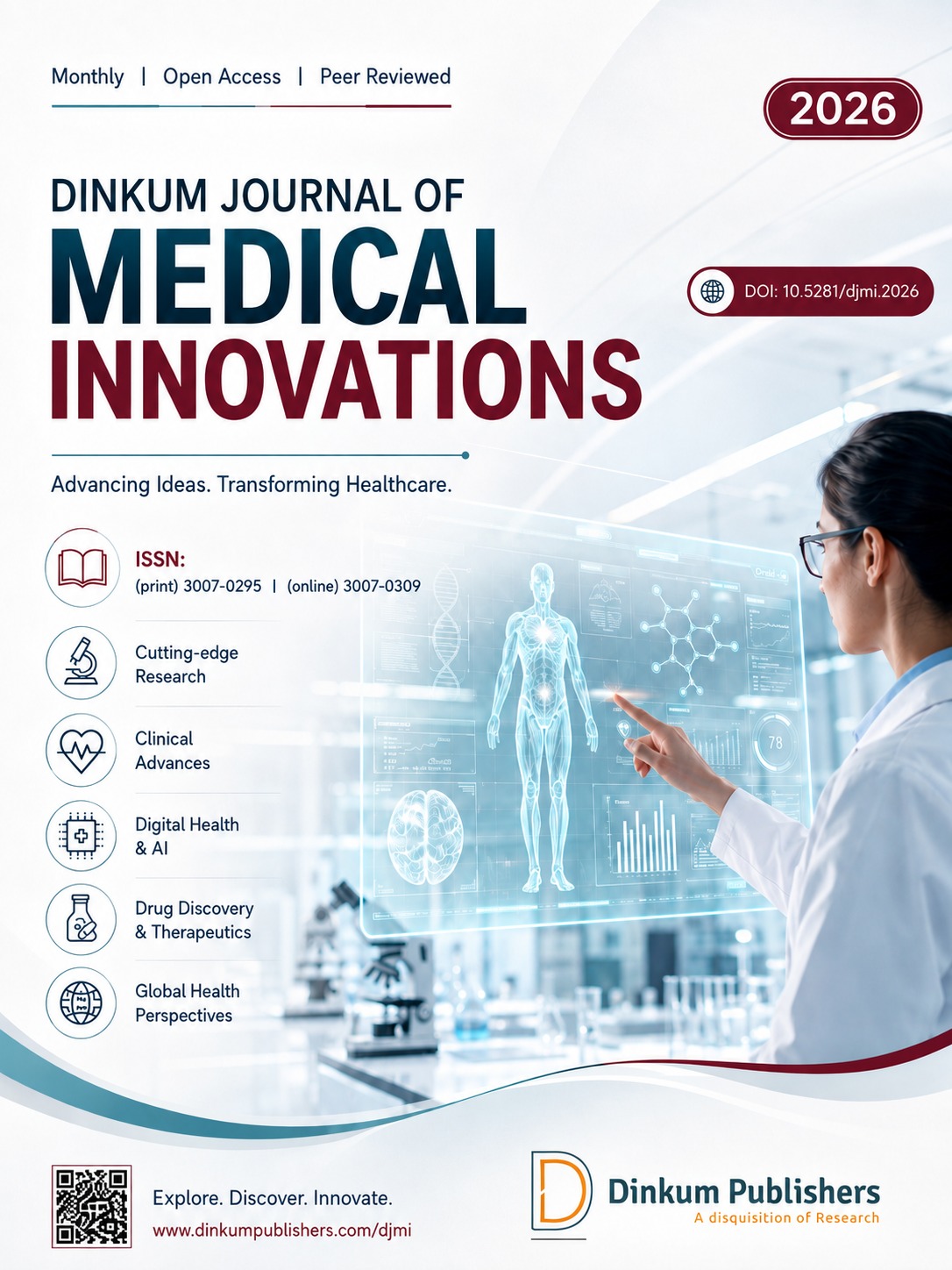
Dinkum Journal of Medical Innovations
Dinkum Journal of Medical Innovations (DJMI) is an open-access, peer-reviewed journal that’s provides an international platform for disseminating novel and significant research across medicine, healthcare, clinical practice, biomedical sciences, & related disciplines. It particularly welcomes original studies that address large knowledge gaps and contribute to innovation in disease diagnosis, therapeutic interventions, patient management, preventive medicine, and evidence-based clinical practice.
DJMI publishes a wide range of scholarly contributions, including original research articles, review articles, meta-analyses, editorials, case studies, perspectives, & letters to the editor. Its broad interdisciplinary approach enables collaboration among professionals working across clinical, biomedical, behavioural, pharmaceutical, diagnostic, and public-health fields.
Author information section provides details about publication ethics, author’s guidelines & fees & funding.
Peer Review Policy
Overview
Dinkum Journal of Medical Innovations (DJMI) follows a rigorous, fair, and transparent peer-review process to ensure the quality, originality, scientific validity, and ethical integrity of published research.
All manuscripts submitted to DJMI undergo an initial editorial assessment followed by external peer review by independent experts with appropriate subject knowledge. The peer-review process assists editors in making informed publication decisions and helps authors improve the scientific quality and clarity of their manuscripts.
Dinkum Journal of Medical Innovations (DJMI) is committed to maintaining high standards of biomedical publishing and follows internationally recognized principles of publication ethics, including the recommendations of the Committee on Publication Ethics (COPE), the International Committee of Medical Journal Editors (ICMJE), and the Principles of Transparency and Best Practice in Scholarly Publishing.
Peer Review Model
Dinkum Journal of Medical Innovations (DJMI) follows a double-blind peer-review process for submitted manuscripts.
Under this system:
- The identities of authors are concealed from reviewers.
- The identities of reviewers are concealed from authors.
- Reviewer assessments are based exclusively on scientific merit, methodological quality, originality, and relevance.
The double-blind approach helps minimize potential bias related to:
- Author reputation.
- Institutional affiliation.
- Geographic location.
- Academic position.
All editorial decisions are made independently based on the quality and integrity of the submitted work.
Editorial Assessment and Peer Review Workflow
All manuscripts follow a structured editorial pathway.
Peer Review Workflow
| Stage | Description |
| Manuscript Submission | Authors submit manuscripts through the journal submission system with required declarations and supporting documents. |
| Initial Editorial Assessment | Editors evaluate scope, originality, ethical compliance, and technical requirements. |
| Research Integrity Screening | Manuscripts undergo plagiarism screening and other integrity checks where applicable. |
| Reviewer Selection | Independent experts are invited based on subject expertise. |
| External Peer Review | Reviewers evaluate scientific quality, methodology, and relevance. |
| Editorial Decision | The Editor makes a decision based on reviewer comments and editorial assessment. |
| Revision Process | Authors address reviewer comments and submit a revised manuscript. |
| Final Decision and Publication | Accepted manuscripts proceed to production and publication. |
Initial Editorial Assessment
Following submission, each manuscript undergoes an editorial evaluation before external peer review.
Editors assess whether the manuscript:
- Falls within the scope of DJMI.
- Addresses a meaningful medical or biomedical research question.
- Meets basic scientific and ethical requirements.
- Follows journal formatting and submission requirements.
The editorial office also evaluates:
- Completeness of submission files.
- Conflict of interest disclosures.
- Funding information.
- Ethical approval statements.
- Author contribution statements.
- Data availability statements.
Manuscripts that do not meet minimum requirements may be returned to authors for correction or rejected before peer review.
Selection of Reviewers
Reviewers are selected based on their expertise, academic background, research experience, and knowledge of the relevant subject area.
Dinkum Journal of Medical Innovations (DJMI) generally assigns two or more independent reviewers for each manuscript.
Reviewers may include:
- Clinical researchers.
- Medical specialists.
- Biomedical scientists.
- Public health researchers.
- Methodological experts.
Additional reviewers may be invited when:
- Specialist expertise is required.
- Reviewer recommendations are substantially different.
- Additional assessment is necessary.
Reviewer Responsibilities
Reviewers provide independent and constructive evaluations to assist editors in maintaining scientific quality.
Reviewers evaluate manuscripts based on:
| Evaluation Area | Reviewer Consideration |
| Originality | Does the manuscript provide new scientific knowledge? |
| Importance | Is the research relevant to medicine and healthcare? |
| Methodology | Are study design and methods appropriate? |
| Statistical Analysis | Are analytical methods valid and correctly interpreted? |
| Ethical Standards | Are ethical requirements fulfilled? |
| Conclusions | Are conclusions supported by evidence? |
| Presentation | Is the manuscript clear and well organized? |
Reviewers should provide professional comments that help authors improve their work.
Reviewer Confidentiality
All manuscripts submitted to Dinkum Journal of Medical Innovations (DJMI) are confidential documents.
Reviewers must:
- Not share manuscript content with unauthorized individuals.
- Not discuss manuscripts outside the peer-review process.
- Not use unpublished information for personal research advantage.
- Maintain confidentiality throughout and after the review process.
Reviewers should remove manuscript files and review materials after completing their evaluation.
Reviewer Conflict of Interest
Reviewers must disclose any potential conflict of interest before accepting a review assignment.
Reviewers should decline invitations when they have:
- Recent collaboration with manuscript authors.
- Personal or professional relationships affecting impartial judgment.
- Financial interests related to the manuscript.
- Institutional competition or conflicts.
- Any circumstance that may influence objective evaluation.
The Editor will assign alternative reviewers whenever a conflict exists.
Editorial Decisions
After receiving reviewer reports, the Editor-in-Chief or assigned Editor makes the final decision.
Possible decisions include:
| Decision | Description |
| Accept | Manuscript is suitable for publication without major changes. |
| Minor Revision | Limited corrections are required before acceptance. |
| Major Revision | Substantial scientific or methodological improvements are required. |
| Reject | Manuscript has significant scientific, ethical, or methodological limitations. |
Editorial decisions consider:
- Reviewer recommendations.
- Scientific quality.
- Research integrity.
- Contribution to medical knowledge.
- Compliance with journal standards.
Revision Process
Authors receiving revision requests should carefully address reviewer comments.
A revised submission should include:
- Revised manuscript.
- Point-by-point response to reviewers.
- Explanation for any comments not addressed.
Revised manuscripts may undergo additional review if required by the Editor.
Peer Review Timeline
Dinkum Journal of Medical Innovations (DJMI) aims to provide a timely and rigorous review process.
| Review Stage | Target Timeline |
| Initial editorial assessment | 7–14 days |
| Reviewer invitation and selection | Up to 7 days |
| Reviewer evaluation | 14–21 days |
| First decision | Approximately 4–6 weeks |
| Revision period | 2–4 weeks |
| Final decision after revision | 1–2 weeks |
| Publication after acceptance | 2–4 weeks |
Actual processing times may vary depending on manuscript complexity and reviewer availability.
Responsibilities of Editors
Editors are responsible for ensuring a fair, transparent, and ethical peer-review process.
Editors must:
- Select appropriate reviewers.
- Maintain confidentiality.
- Manage conflicts of interest.
- Ensure unbiased evaluation.
- Base decisions on scientific merit.
- Address ethical concerns appropriately.
Editors do not allow commercial, institutional, or personal interests to influence publication decisions.
Research Reporting Guidelines
Dinkum Journal of Medical Innovations (DJMI) encourages authors to follow internationally accepted reporting standards to improve transparency and reproducibility.
Authors should follow relevant guidelines where applicable:
| Study Type | Reporting Guideline |
| Randomized clinical trials | CONSORT |
| Systematic reviews and meta-analyses | PRISMA |
| Observational studies | STROBE |
| Diagnostic accuracy studies | STARD |
| Case reports | CARE |
| Animal research | ARRIVE |
Authors may be requested to submit completed reporting checklists during submission.
Special Issue Peer Review
Manuscripts submitted to Dinkum Journal of Medical Innovations (DJMI) special issues undergo the same peer-review standards as regular submissions.
Guest editors responsible for special issues must:
- Follow DJMI editorial policies.
- Maintain editorial independence.
- Declare conflicts of interest.
- Ensure appropriate reviewer selection.
Prevention of Peer Review Manipulation
Dinkum Journal of Medical Innovations (DJMI) is committed to protecting the integrity of the peer-review system.
The journal may implement measures including:
- Verification of reviewer identity.
- Careful evaluation of suggested reviewers.
- Monitoring unusual review patterns.
- Investigation of suspected peer-review manipulation.
Suspected cases are handled according to COPE recommendations.
Artificial Intelligence and Peer Review
Dinkum Journal of Medical Innovations (DJMI) recognizes the increasing use of artificial intelligence tools in scholarly publishing.
Reviewers must ensure that:
- Confidential manuscript information is not uploaded to publicly available AI platforms.
- AI tools do not replace independent expert judgment.
- Review reports represent the reviewer’s own professional evaluation.
Reviewers remain responsible for confidentiality, accuracy, and ethical conduct.
Appeals and Complaints
Authors may appeal editorial decisions when they believe a decision resulted from factual errors or inappropriate evaluation.
Appeals should include:
- Clear explanation of concerns.
- Specific responses to reviewer comments.
- Scientific justification.
Appeals are reviewed by senior editorial members who were not directly involved in the original decision whenever possible.
Post-Publication Review
Scientific discussion continues after publication.
Dinkum Journal of Medical Innovations (DJMI) welcomes communication regarding:
- Scientific comments.
- Corrections.
- Ethical concerns.
- Potential errors in published articles.
All concerns are investigated according to established publication ethics practices.
Editorial Independence
Dinkum Journal of Medical Innovations (DJMI) maintains editorial independence throughout the publication process.
Publication decisions are based solely on:
- Scientific quality.
- Research integrity.
- Methodological rigor.
- Contribution to medical knowledge.
The publisher does not influence editorial decisions regarding acceptance or rejection of manuscripts.
Ethical Standards
Dinkum Journal of Medical Innovations (DJMI) follows internationally recognized standards for responsible scholarly publishing, including:
- Committee on Publication Ethics (COPE) principles.
- International Committee of Medical Journal Editors (ICMJE) recommendations.
- Principles of Transparency and Best Practice in Scholarly Publishing.
Through this peer-review framework, Dinkum Journal of Medical Innovations (DJMI) aims to promote reliable, ethical, and high-quality medical research.
Find groundbreaking researches & novel clinically case studies