

Publication History
Submitted: June 13, 2025
Accepted: July 10, 2025
Published: October 31, 2025
Identification
D-0506
DOI
https://doi.org/10.71017/djmi.4.10.d-0506
Citation
Dipendra Timilsina (2025). Incomplete Abortion, as a Complication of Medical Methods of Abortion Presenting in Tertiary Care Hospital of Nepal. Dinkum Journal of Medical Innovations, 4(10):720-729.
Copyright
© 2025 The Author(s).

720-729
Incomplete Abortion, as a Complication of Medical Methods of Abortion Presenting in Tertiary Care Hospital of NepalOriginal Article
Dipendra Timilsina1*
- Department of Internal Medicine, Maharajgunj Medical Campus, Kathmandu, Nepal.
* Correspondence: dipenpranami95@gmail.com
Abstract: Incomplete abortion is one of the expected complications of medical methods of abortion. However, the risk of incomplete abortion is increased more with the inadvertent use of abortion pills as over the counter drugs from local pharmacy shop without the prescription by a registered doctor. With the use of medical abortion from local pharmacy, patient use the drugs at inappropriate gestational age with incorrect dosage and incorrect timing of administration culminating in incomplete abortion which is an emergency condition that can increase the maternal morbidity and mortality if the patient cannot get access to proper health services on time .This study determined the methods of medical abortion used by the patient in the form of source of drug , dosage and number of drugs and timing and route of administration of drugs. This is a single-center unmatched case-control observational (descriptive and analytical study), carried out among pregnant women up to 9 weeks of pregnancy who had used medical abortion pills and presented with per vaginal bleeding in emergency Department of Tribhuwan University Teaching Hospital of Nepal. This one-year study included N=84 patients, of whom 82 presented with incomplete abortion and 2 with complete abortions. The mean age of the patients was 27.70 ± 4.84 years, while the mean gestational age was 7.25 ± 0.68 weeks. Most patients, 65 (77.38%), had obtained medical abortion pills from a nearby local pharmacy, whereas 19 (22.62%) had used medicines prescribed by a registered medical practitioner. All patients reported using two drugs; however, none were aware of the correct dosage. Regarding the pattern of drug intake, 57 patients (67.87%) had taken both drugs together at the same time, while 27 patients (32.14%) had taken one drug on the first day and the second drug on the following day. In terms of the route of administration, 74 patients (88.10%) had taken both drugs orally, whereas 10 patients (11.90%) had taken one drug orally and the other through the vaginal route. The mean hemoglobin level was 10.29 ± 1.30 g/dL. These findings suggest that the risk of incomplete abortion may increase when medical abortion is performed without appropriate medical supervision, particularly when drugs are obtained from unregistered sources or used with incorrect timing and dosage.
Keywords: incomplete abortion, medical methods, tertiary care hospital, Nepal
- INTRODUCTION
Medical management of abortion generally involves either a combination regimen of mifepristone and misoprostol or a misoprostol-only regimen. Medical abortion care plays a crucial role in providing access to safe, effective and acceptable abortion care. Medical abortion care reduces the need for skilled surgical abortion providers and offers a non-invasive and highly acceptable option to pregnant individuals. Medical abortion has been legalized in Nepal since 2002 A.D [1]. According to WHO, medical abortion includes use of Mifepristone 200mg orally followed 36-48 hours later by misoprostol 200mcg 4 tabs intravaginally, sublingually or buccally and is considered safe up to 9 weeks of pregnancy [2]. As per WHO Medical Management of Abortion Guidelines 2018, “Incomplete abortion is defined by clinical presence of open cervical OS and bleeding whereby all products of conceptus have not been expelled from the uterus. Common symptoms include vaginal bleeding and abdominal pain. Incomplete abortion should also be suspected if, upon visual examination, the expulsed tissue is not consistent with the estimated duration of pregnancy [3].” This typical regimen requires three visits to be put into practice in the clinic. The first appointment entails patient education and permission, as well as the determination of gestational age and treatment. Specific counseling or consent must take place far in advance of treatment in some regions, as required by legislation. Depending on local standards and resources, gestational age is determined in a variety of ways [4]. Some practitioners rely primarily on a woman’s menstrual history and pelvic examination, with sonography reserved for exceptional instances; others, particularly in the United States, employ sonography on a regular basis for all patients. Similarly, some providers only measure hemoglobin or hematocrit in women who are at risk for anemia due to poor health, poor nutrition, or a history of bleeding, while others do it in all women. Mifepristone treatment consists of 600 mg (three 200-mg pills) given orally in front of a healthcare provider. The second visit takes place two days later, between 36 and 48 hours [5]. Mifepristone and oral misoprostol are allowed for usage through 49 days of pregnancy in France, the United States, and other countries. As indicated by the first large-scale US clinical research, which was conducted by the Population Council in women up to 63 days’ gestation, the efficacy of this regimen drops dramatically after that. Mifepristone 600 mg orally was given to women at 17 clinical locations, who were then switched to misoprostol 400 mg orally two days later. The ladies were required to stay in the clinic for at least 4 hours of observation before returning 12 days later for a final appointment, during which a physical or ultrasound examination was performed to ensure complete expulsion [6]. The government of Nepal registered MA brands (combined regimens of mifepristone and misoprostol) have been available only on prescription through government accredited safe abortion providers since 2009 A.D[7]. Despite the restrictions, registered and unregistered brands of MAs are readily available for purchase at pharmacies. An estimated 60% of all abortions performed in 2014 was unsafe, with unsafe abortion continuing to be a leading contributor to maternal mortality. Of the various complications of unsafe abortion, incomplete abortion is encountered to be the commonest complication contributing to increased maternal deaths [8]. Since its legalization, rate of medical abortion has increased for various unintended pregnancies. In Nepal, MA is the most frequently accessed method of pregnancy termination (79%) of the estimated 3,23,100 abortion performed in Nepal during 2014, nearly 60% (186,100) were unsafe, having been carried out by untrained or unregistered providers or self-induced [9]. To develop effective interventions supporting access to safe abortion, existing reasons for unsafe care need to be identified. Little is known about women’s unsafe abortion practice following legislation, including the contexts in which women seek care from untrained providers and the abortion methods that bring women to postabortion care facilities. This research will focus on the women presenting with induced abortion related complications and seek for the factors contributing to the problems in induced abortion [10]. The drugs are commonly administered in the presence of clinicians, which is known as provider‐administered medical abortion. In self‐administered medical abortion, drugs are administered by the woman herself without the supervision of a healthcare provider during at least one stage of the drug protocol [11]. Self‐administration of medical abortion has the potential to provide women with control over the abortion process. In settings where there is a shortage of healthcare providers, self‐administration may reduce the burden on the health system [12]. However, it remains unclear whether self‐administration of medical abortion is effective and safe. It is important to understand whether women can safely and effectively terminate their own pregnancies when having access to accurate and adequate information, high‐quality drugs, and facility‐based care in case of complications [13]. Medical abortion pills are being used as the over-the-counter medicine in Nepal nowadays resulting in incomplete abortion which is one of the causes of increased maternal mortality [14]. Literature review from my side revealed very few such studies have been done in Nepal. This study helped in understanding the consequences of injudicious use of medical abortion pills at inappropriate gestational age, improper dosage, route and timing. The findings of the study guided the direction of future research work in abortion care and management. This studied the incomplete abortion as a complication among users of medical abortion methods up to 9 weeks intrauterine pregnancy presenting to TUTH.
- MATERIALS & METHOD
This study used a Quantitative Research method and is an Observational Cross Sectional Study. Patients who presented with PV bleeding up to 9 weeks of gestation and had taken as a sample population. As incomplete abortion is an emergency condition, my study site was Emergency ward of TUTH. Nonprobability sampling method was used. As this study try to estimate prevalence of Incomplete Abortion in study population
Sample size (n) = Z^2 p * q/ d^2 Where
P =prevalence
q=100-p
d=allowable error i.e.10%
n=sample size Z= 1.96 Prevalence is 30% as per the previous study done
Then Sample size (n)=1.96^2 *30*70 /10^2 =80
Incomplete abortion is defined by clinical presence of open cervical os and bleeding whereby all products of conceptus have not been expelled from the uterus. Common symptoms include vaginal bleeding and abdominal pain. Incomplete abortion should also be suspected if, upon visual examination, the expulsed tissue is not consistent with the estimated duration of pregnancy. Pregnant women of all age groups up to 9 weeks of gestation who had taken MTP presenting in Emergency Department of TUTH with history of per vaginal bleeding. Consent was taken for participation after a brief introduction and highlighting the study to the patient and accompanying relatives. After informed consent was obtained, the patient was screened to study filling proforma. Potential inclusion and exclusion criteria reviewed. People who meet the criteria of inclusion and without having exclusion criteria are enrolled in the study. After interviewing the component of the history and examination section, patient physical examination performed as necessary. Per vaginal and speculum examination findings copied as per Gynecologist review form. Investigations like Hemoglobin level and USG findings were recorded. After completion of the data collection, data were entered using IBM SPSS STATISTICS DATA EDITOR Version 26 and analyzed by appropriate statistical tools. Categorical data were expressed as frequencies and corresponding percentages; Parametric data were expressed as mean (SD) and compared by independent t-test, Pearson’s correlation coefficient (r) test as applicable. Appropriate tables and bar diagrams were made. The level of significance for all analytical tests was set at 0.05 and, if the p-value is less than 0.05, it was regarded as statistically significant.
- RESULTS & DISCUSSION
The study was conducted at Emergency ward of Tribhuvan University Teaching Hospital from. Data was analyzed by Unpaired Student’s t-test and Pearson’s correlation coefficient (r) test as applicable. Pregnant women up to 9 weeks of gestation with intrauterine pregnancy presenting with pv bleeding was included in the study after excluding the cases under exclusion criteria. Total of 84 cases were enrolled in the study. Out of 84, 82 had incomplete abortion and 2 had complete abortion. Mean age of the patient was 27.70 years ±4.84 years. Mean age of gestation was 7.25 weeks ±0.68 weeks.65 of the patient i.e. 77.38 % of the patient had taken the medical abortion pills from nearby local pharmacy and remaining of 19 patient i.e. 22.62 % had taken the medicine prescribed by registered doctor. All of the patients had taken 2 drugs and all of them are unaware about the dosage of drugs used by them .57 of the patient i.e. 67.87% had taken both drug together at a time and 27 i.e.32.14% had taken 1 drug on first day and next the other day .On route of drug administration, 74 i.e. 88.10 % had taken both of the drugs orally and 10 i.e. 11.90 % had taken one drug orally and other via vaginal route. Mean Hemoglobin of the patient was found to be 10.29 ± 1.3.
Mean age= 27.70 years ±4.84 years
Median age= 28 with IQR (Inter quartile range) of 6
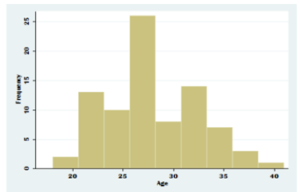
Figure 01: Age Distribution
Gestational Age
Mean age= 7.25 weeks ±0.68 weeks
Median age= 7.20 with IQR (Inter quartile range) of 1.05
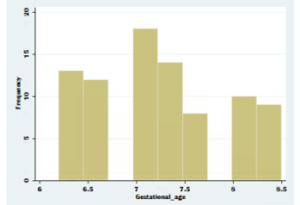
Figure 02: Gestational Age
Table 01: Parity distribution of patients with medical abortion
| Parity (n=84) | Frequency | Percentage (%) |
| 1 | 39 | 46.43 |
| 2 | 27 | 32.14 |
| 0 | 12 | 14.29 |
| 3 | 5 | 5.95 |
| 4 | 1 | 1.19 |
Table 02: Source of drugs consumed by patients following MA
| Parity (n=84) | Frequency | Percentage (%) |
| Local pharmacy without prescription by registered doctor | 65 | 77.38 |
| Prescribed by registered doctor | 19 | 22.62 |
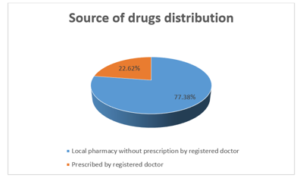
Figure 03: Source of drug distribution
Table 03: Number of drugs taken

Table 04: Dosage of drug used
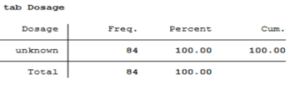
Table 05: Timing of drugs taken by MA patients
| Timing of drugs taken (n=84) | Frequency | Percentage (%) |
| Both together | 57 | 67.87 |
| 1 tablet once followed by another next day | 27 | 32.14 |
Table 06: Route of drug administration
| Route of drug administration (n=84) | Frequency | Percentage (%) |
| Both oral | 74 | 88.10 |
| One oral other vaginal | 10 | 11.90 |
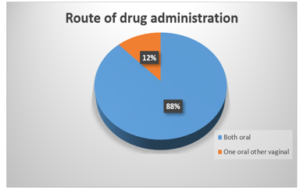
Figure 04: Route of drug administration
Table 07: Types of abortion
| Types of abortion (n=84) | Frequency | Percentage (%) |
| Complete | 2 | 2.38 |
| Incomplete | 82 | 97.62 |
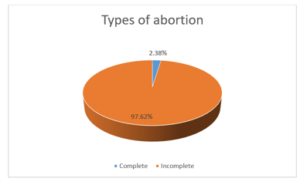
Figure 05: Types of abortion
Table 08: Relation between types of abortion with age
| Abortion type | Mean Age | Standard error | Standard deviation | 95% CI | t-test | p-value |
| Complete | 36.50 | 4.5 | 6.36 | -20.67-93.67 | 2.90 | 0.0047 |
| Incomplete | 27.60 | 0.46 | 4.24 | 26.67-28.54 | ||
| Diff | 8.89 | 3.05 | 2.80-14.97 |
There was a significant difference between mean age of complete and incomplete abortion (p-value =0.0047). The mean age of complete abortion was on average 8.89 years higher than the incomplete age. (98%CI: 2.80-14.19).
Table 09: Relation between types of abortion with gestational age
| Abortion type | Mean Gestational Age | Standard error | Standard deviation | 95% CI | t-test | p-value |
| Complete | 7.70 | 0.60 | 0.84 | 0.07-15.32 | 0.93 | 0.35 |
| Incomplete | 7.24 | 0.07 | 0.68 | 7.09-7.39 | ||
| Diff | 0.45 | 3.05 | 2.80-14.97 |
There was no significant difference between mean gestational age of complete and incomplete abortion (p-value =0.35).
Table 10: Relation between types of abortion with parity
| Parity (n=84)
|
Abortion type | Total (%) | P value | |
| Complete | Incomplete | |||
| 0 | 0(0.30) | 12(11.70) | 12 |
0.10 |
| 1 | 0(0.90) | 39(38.10) | 39 | |
| 2 | 1(0.60) | 26(26.40) | 27 | |
| 3 | 1(0.10) | 4 (4.90) | 5 | |
| 4 | 0(0.0) | 1(1.00) | 1 | |
There is no statistical association between the parity with the types of the abortion (P-value>-0.05).
Table 11: Relation between types of abortion with source of drugs used
| Source of drugs used (n=84)
|
Abortion type | Total (%) | P value | |
| Complete | Incomplete | |||
| Local pharmacy without prescription by registered doctor | 0(1.50) | 65(63.50) | 65 |
0.048 |
| Prescribed by registered doctor | 2(0.50) | 17(18.50) | 19 | |
There is a statistical association between the types of the abortion with source of drugs used. (P-value<-0.05).
Table 12: Relation between types of abortion with timing of drugs taken
| Timing (n=84)
|
Abortion type | Total (%) | P value | |
| Complete | Incomplete | |||
| Both together | 0 (1.40) | 57 (55.60) | 57 |
0.10 |
| 1 tablet once followed by other next day | 2(0.60) | 25 (26.40) | 27 | |
There is no statistical association between the timing of drugs administration with the types of the abortion (P-value>-0.05).
Table 13: Relation between types of abortion with route of drugs taken
| Route of drugs taken (n=84) | Abortion type | Total (%) | P value | |
| Complete | Incomplete | |||
| Both oral | 0 (1.80) | 74 (72.20) | 74 |
0.013 |
| One oral other vaginal | 2(0.20) | 8 (9.80) | 10 | |
There is a statistical difference between the route of drugs administration with the types of the abortion (P-value<-0.05). Out of 74 patients with oral intake 72 had incomplete abortion whereas out of 10 patients with one oral other vaginal intake of medicines, 8 had incomplete abortion
Table 14: Relation between types of abortion with hemoglobin level
| Abortion type | Mean Hb | Standard error | Standard deviation | 95% CI | t-test | p-value |
| Complete | 11.40 | 0.90 | 1.27 | -0.03-22.83 | 0.97 | 0.33 |
| Incomplete | 10.47 | 0.14 | 1.33 | 10.10-10.76 | ||
| Diff | 0.92 | 0.95 | -0.97-2.82 |
There was no significant association between mean Hb of complete and incomplete abortion (p-value =0.33).
Medical management of abortion generally involves either a combination regimen of mifepristone and misoprostol or a misoprostol-only regimen [15]. The combination of oral mifepristone and vaginal misoprostol is currently approved for medical abortion in women with amenorrhea up to 49 days (7 weeks gestation). Counseling, willingness for three visits, readiness for surgical method in case of failure, additional consent, and MMA client card with details of the patient along with details of the doctor, and place to report along with contact number in case of emergency are some of the methods to make MMA safe as laid out in Comprehensive abortion care training and service guidelines. Failure rates are low and problems are infrequent when rules are meticulously followed [16]. In our study, mean gestational age was found to be 7.25 weeks ±0.68 weeks. Among them incomplete abortion was found in most of the patients using medical methods of abortion. There was a statistical association between the types of the abortion with source of drugs used. (P-value<-0.05). Out of 84, 65 patients taking drugs from local pharmacy had incomplete abortion and 17 patient taking drugs from registered doctor had incomplete abortion. There was a significant difference between mean age of complete and incomplete abortion (p-value =0.0047) [17]. The mean age of complete abortion was on average 8.89 years higher than the incomplete age. (98%CI: 2.80-14.19). There was no significant difference between mean gestational age of complete and incomplete abortion (p-value =0.35). There is a statistical difference between the route of drugs administration with the types of the abortion (P-value<-0.05). Out of 74 patients with oral intake 72 had incomplete abortion whereas out of 10 patients with one oral other vaginal intake of medicines, 8 had incomplete abortion [18]. In a study by [19], single drug(misoprostol) was used in 78.1 % women compared to double drug (mifepristone and misoprostol) in 21.9 %women. In only two women, drug was used vaginally, out of which one was combined with oral mifepristone. Out of the women who received double drug, only one woman required blood transfusion. She had received MMA at higher gestational age than recommendation (10 weeks and 2 days). In women receiving MMA, follow-up was advised in only 31.2 % (n=10), and only 9.3 % (n=2) women followed up with the same doctor. A study by [20] has shown maternal mortality 9 %among women who presented with unsafe abortions. However, the majority of women reported with severe sequelae such as intestinal damage or septicemia. In contrast, as compared to septic or surgical abortion, the observed mortality rate is considerably lower with medication abortion, which is a key advantage of MMA. There was no maternal fatality among patients.
- CONCLUSIONS
Before prescribing medical methods of abortion (MMA), a comprehensive clinical history and physical examination are essential to confirm gestational age and exclude any contraindications. Although incomplete abortion is a recognized complication of MMA, its risk can be reduced through proper pre-treatment assessment, appropriate drug selection, correct dosage, and adherence to recommended treatment protocols. The use of combination therapy under medical supervision is more effective and safer than the inappropriate use of a single drug or unsupervised medication. Adequate training of healthcare providers and awareness of relevant legal guidelines are necessary to ensure safe abortion care. Self-administration of abortion pills or over-the-counter use without medical consultation should be strongly discouraged. Both clinicians and women seeking MMA should be informed about possible adverse effects, the expected amount of bleeding, warning signs that require urgent medical attention, and the importance of timely follow-up. Health education also plays an important role in helping women make informed decisions regarding contraception and safe abortion services when needed. MMA has contributed significantly to improving access to safer abortion care and reducing abortion-related morbidity and mortality. However, to achieve optimal safety and effectiveness, MMA should be provided only under the supervision of trained and qualified healthcare professionals.
REFERENCES
- Clarke B, Hodgson HJF. Medical management. Vol. 35, British Journal of Hospital Medicine. 1986. 146–152 p.
- Creinin MD, Danielsson KG. Medical Abortion in Early Pregnancy. Manag Unintended Abnorm Pregnancy Compr Abort Care. 2009;111–34.
- Rogers C, Sapkota S, Paudel R, Dantas JAR. Medical abortion in Nepal: A qualitative study on women’s experiences at safe abortion services and pharmacies. Reprod Health. 2019;16(1).
- Pawde AA, Ambadkar A, Chauhan AR. A Study of Incomplete Abortion Following Medical Method of Abortion (MMA). J Obstet Gynecol India. 2016 Aug 1;66(4):239–43.
- Gambir K, Kim C, Necastro KA, Ganatra B, Ngo TD. Self-administered versus provider-administered medical abortion. Cochrane Database Syst Rev. 2020;2020(3).
- Ojha N, Bista KDB. Situation analysis of patients attending TU teaching hospital after medical abortion with problems and complications. J Nepal Med Assoc. 2013;52(191):466–70.
- Giri KP, Dangal G. Comparison of Medical Abortion with Manual Vacuum Aspiration in Termination of Pregnancy up to Nine Weeks. J Nepal Health Res Counc. 2020;18(1).
- Hsia JK, Lohr PA, Taylor J, Creinin MD. Medical abortion with mifepristone and vaginal misoprostol between 64 and 70 days’ gestation. Contraception. 2019;100(3).
- Pathak A. MEDICAL METHODS OF ABORTION (MMA), HOW SAFE? Int J Sci Res. 2021;
- Sonali D, Kanan Y, Ajit D, Kapil K. “Comparative study of medical abortion by Mifepristone with vaginal Misoprostol in women < 49 days versus 50-63 days of amenorrhoea.” J Obstet Gynecol India. 2010;60(5):403–7.
- World Health Organization (WHO). Safe Abortion: Technical and Policy Guidance for Health Systems. Geneva: WHO; 2003.
- Reghavan S, Comendant R, Digol I, et al. Two-pill regimens of misoprostol after mifepristone medical abortion through 63 days gestational age: a randomized controlled trial of sublingual and oral Contraception. 2009;79(2):84-90
- Hollie Richards (2025). The Expanding Universe of Hope: A Comprehensive Review of Advancements in Assisted Reproductive Technologies. Dinkum Journal of Medical Innovations, 4(02):53-57.
- Shannon C, Brothers LP, Philip NM, Winikoff B. Infection after medical abortion: a review of the Contraception. 2004;70(3):183-90.
- Henderson JT, Hwang AC, Harper CC, Stewart FH. Safety of mifepristone abortions in clinical use. 2005;72(3):175-8.
- Winikoff B, Sivin I, Coyaji KJ, Cabezas E, Bilian X, Sujuan G, et al. Safety, efficacy and acceptability of medical abortion in China, Cuba and India: a comparative trial of mifepristone-misoprostol versus surgical abortion. Am J Obstet Gynecol. 1997; 176:431-7
- Spitz IM, Bardin CW, Benton L, Robbins A. Early pregnancy termination with mifepristone and misoprostol in the United States. N Engl J Med. 1998; 338:1241-7
- Bennet IM, Baylson M, Kalkstein K, Gillespie G, Bellamy SL, Fleischmen J. Early abortion in family Medicine: Clinical outcomes. Ann Fam Med. 2009;7(6):527-33
- Kruse B, Poppema S, Crenin MD, Paul M. Management of side effects and complications in medical abortion. Am J Obstet Gynecol. 2000;183: S65-S75
- Ms. Saroja Poudel & Dr. Rajesh Niraula (2024). Comprehensive study of Placenta Previa & Its Psychological Consequences. Dinkum Journal of Medical Innovations, 3(02):174-187.
Publication History
Submitted: June 13, 2025
Accepted: July 10, 2025
Published: October 31, 2025
Identification
D-0506
DOI
https://doi.org/10.71017/djmi.4.10.d-0506
Citation
Dipendra Timilsina (2025). Incomplete Abortion, as a Complication of Medical Methods of Abortion Presenting in Tertiary Care Hospital of Nepal. Dinkum Journal of Medical Innovations, 4(10):720-729.
Copyright
© 2025 The Author(s).