


Publication History
Submitted: November 07, 2025
Accepted: November 28, 2025
Published: November 30, 2025
Identification
D-0549
DOI
https://doi.org/10.71017/djmi.4.11.d-0549
Citation
Najat Alhassan, Adelaide Maria Ansah Ofei & Atswei Adzo Kwashie 3 (2025). The Influence of Nurses’ Job Demands and Job Resources on Nurses’ Job Satisfaction and Turnover: The Moderating Role of Personality. Dinkum Journal of Medical Innovations, 4(11):755-769.
Copyright
© 2025 The Author(s).

770-786
The Influence of Nurses’ Job Demands and Job Resources on Nurses’ Job Satisfaction and Turnover: The Moderating Role of PersonalityOriginal Article
Najat Alhassan 1*, Adelaide Maria Ansah Ofei 2, Atswei Adzo Kwashie 3
- School of Nursing and Midwifery, University of Ghana, Ghana.
- Professor, School of Nursing and Midwifery, University of Ghana, Ghana.
- Senior Lecturer, School of Nursing and Midwifery, University of Ghana, Ghana.
* Correspondence: Najatal2021@uds.edu.gh
Abstract: Nursing emphasizes caring for humanity so that people, families and communities can attain optimal health and quality of life. This imposes enormous job stress on nurses; thus, experienced nurses often tend to leave while career starters do not want to venture into the profession. Although research on nurses’ turnover and job satisfaction has received considerable attention in the Ghanaian context, little is known of the influence of nurse’s personality on their turnover and job satisfaction, especially from the job demands and job resources perspective. This study examined the influence of nurses’ job demands and job resources on their turnover and job satisfaction. The study employed the quantitative research design to collect data on nurses using several validated scales in a cross-sectional survey. The target population was all nurses working in the Tamale teaching hospital and the multistage sampling strategy was adopted to recruit 264 nurses for the study. The data collected was recorded, coded and analyzed using the Statistical Product and Service Solutions software (SPSS V.21) for windows. Pearson product moment correlation, linear regression and hierarchical regression analysis were used to test hypothesis. The study was male dominated (55.3%) and the modal age of respondents was 29-38 years. The study established a causal relationship between nurses’ job demands and their turnover intention as well nurses’ job demands and their job satisfaction. Nurses’ personality was found to moderate the relationship between nurses’ job demands and turnover as well as nurses’ job resources and job satisfaction. It is recommended that the Ministry of health should formulate and implement merit-based pay and incentive schemes to reward loyalty and hard work. Health facility managers must also develop tailored training programs for nurse Supervisors, particularly on people management skills.
Keywords: influence, nurses’ job demands, job resources, job satisfaction, role of personality
- INTRODUCTION
Nursing is widely considered a noble profession that places strong emphasis on caring for people, families, and communities for them to achieve the best possible health and quality of life [1]. The profession is one of people-centeredness which focuses on humanity with enormous demands on the nursing staff. Nursing staff are expected to build strong bonds with patients, exhibit compassion and empathy, work as patients’ advocates and actively participate in the care of both patients’ and patients’ relatives. Nurses job is essential to society since nurses are the foundation of the healthcare system’s capability to provide high-quality clinical services [2,3]. In other words, the total care of patients, guaranteeing patient safety and well-being is the responsibility of the nursing staff. These enormous job demands on nurses make nursing a stressful profession and deprive patients of quality care. As a result, experienced nurses often tend to leave the profession whiles career starters do not even want to venture into nursing due to the high workload, emotionally exhausting and physically demanding nature of the noble profession [4]. The excessive physical and emotional job demands on nursing staff have been significantly linked to health impairment in the form of fatigue, burnout, sicknesses and Musculoskeletal disorders (MSD) [5]. Notably, the high job demands on nurses are often downplayed, forgetting that nurses are also social beings who have family responsibilities as well [6]. The foregoing, notwithstanding, the demands on nursing staff and health care organizations have become more challenging in the 21st century. The harsh reality is that while the demands on nurses have soared, the characteristics of the work environment (job resources) that are supposed to provide support for nurses’ wellbeing have dwindled. An author [7] recognized that the job resources of nurses have both intrinsic and extrinsic motivational potential to foster employees’ wellbeing and work engagement. Yet this important work characteristic which has been argued to be the most important predictor of work engagement has taken a nose-dive [8]. In fact, available evidence points to the fact that job resources of nurses have the simultaneous benefit of improving job performance as well as lessening job demands and its related psychological and physiological costs [9]. Extant literature considers social support, performance feedback, self-determination, autonomy, role clarity and control as the constituents of job resources. An author [10] concurs and advanced the argument that imbalances in the two-work environment (job resources and job demands) explain why workers in a particular job may be stressed, dissatisfied or want to leave. Closely linked with the interactive role of nurses’ job resources and job demands is the satisfaction with their work and counterproductive behaviours. An author [11] views job satisfaction as “the pleasurable emotional state resulting from one’s job as either achieving or facilitating the achievement of one’s values”. Sufficient evidence exists in literature to show that nurses job satisfaction and withdrawal behaviours have relational traces to the interface of their job resources and job demands [12,13]. Nurses are more likely to be dissatisfied with their work when they are wearied following high workload or difficult tasks with little or no supervisory support or role clarity [14]. In a very recent study, emotional tiredness was seen to be caused by work stress leading to reduced job satisfaction [15]. Likewise, the inequities in nurses’ job resources and demands have been demonstrated to cause their turnover intentions [16]. Whiles the preceding paragraph is noteworthy, the significant role of nurse’s personalities must not be glossed over. One’s personality is his persistent disposition and tendency to behave in certain ways, and it’s widely used in predicting individuals work behaviours [17]. Nurse’s personality has been found to help explain how they process and responds to environmental and situational cues [18]. Scholars have formulated varied personality inventories or models to determine individuals’ respective personalities. The most widely researched personality model is the big five personality typology by [19]. This model identifies the elements of personality as neuroticism, agreeableness, extraversion, conscientiousness and openness to experience [20]. Studies examining the link between these elements of personality and staff’s intention to leave and job satisfaction have produced incongruous results [21]. For instance, whereas favorable attributes like conscientiousness, neuroticism and agreeableness were adversely correlated with turnover intention [22], positive traits like openness to experience and extraversion were associated to turnover intention. The preceding paragraph notwithstanding, the challenges on the nursing workforce in the twenty first century is occasioned by high job demands with disproportionate job resources to function. The worst part is that these are happening in the face of critical shortages of nurses [23]. The critical shortages of nurses have been confirmed by the World Health Organization (2016). The WHO projects a near thirteen million (12.9) shortages of nurses by the year 2035. The incidence and consequences of high nurses’ turnover will be devastating in developing countries, particularly in Africa, where turnover rates are estimated to be 25.9% and beyond [24]. The attrition of nurses is reported to have created health care crisis in some African countries and has adversely affected provision of quality care to patients (Ayalew et al., 2021). The World Health Organization [25] has long hinted that of the fifty-seven (57) countries reported to have critical shortage of nurses, thirty-six (36) of them are in Africa. In Ghana, the nurse to population ratio has dwindled from nine hundred and fifty-nine (959) in the year 2014 to five hundred and forty-two (542) in the year 2015 [26] giving an indication of critical shortage of nurses as it puts the nurse per 10000 population at 2.5. The situation is exacerbated by the fact that the rate at which trainee nurses intend to leave far exceeds the rate at which they can be trained to replace existing staff. High nurse turnover is a significant issue in Ghana’s health care setting, affecting the health industry’s quest to deliver and maintain quality care [14]. Addressing this issue has the probability of enhancing the quality of patient care in the majority of the country’s health-care facilities. Worryingly, because of the related difficulties of working in the health sector, more nurses are leaving Ghana, either for better conditions in the developed economies or to pursue other careers [21]. This study therefore seemed to fill the gap in literature using the job resource and demands model.
- MATERIALS & METHOD
This study used a cross-sectional quantitative survey approach to gauge nurses’ perception of their job demands/job resources, personality, job satisfaction and their turnover intention in the Tamale Teaching Hospital. Nurses in the target population who met the inclusion criteria for selection as research participants were recruited using multistage sampling technique. The data collection and analysis were done after adhering to ethical protocols of research. Microsoft excel was used to capture the capture participants’ responses from the questionnaires. The excel data was subsequently exported to the statistical product and services solutions software (SPSS version 24) in a form ready for both descriptive and inferential sstatistics. The determination of the sample size of the population of nursing staff in the hospital was computed using the [27] formula for determining sample sizes shown below.
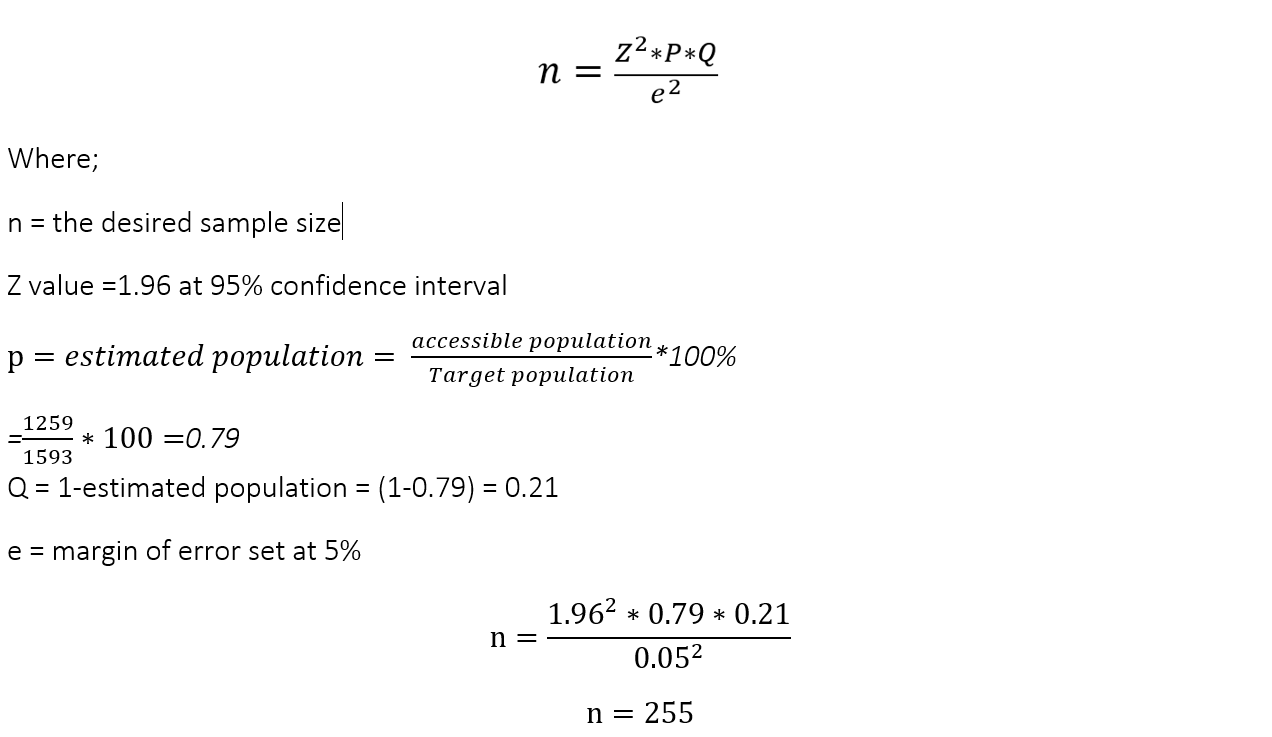 The sample size was calculated to be 255 and was upwardly adjusted by 10% to 280 to make provision for non-response rate and possible excess missing data. The formula for the distribution of the questionnaires is presented below.

Finally, in each sub-BMC, simple randomco sampling strategy was used to recruit participants who met the inclusion criteria and consented to participate in the study. Table 01 shows the distribution of the questionnaires to the sub-BMC’s.
| Number | Sub-BMC | Population | % | Quota | Sample |
| 1 | OBG | 450 | 36 | 100 | 93 |
| 2 | Pediatrics | 225 | 18 | 50 | 50 |
| 3 | Medicine | 157 | 12 | 35 | 35 |
| 4 | Surgery | 360 | 29 | 80 | 73 |
| 5 | A&E | 67 | 5 | 15 | 13 |
| Total | 1259 | 100 | 280 | 264 |
Data was gathered using adopted scales from several validated scales. The questionnaire was structured according to the constructs of the study with appropriate instructions for each section. The demographic data collected includes gender, age, marital status, educational level, professional category, job tenure, job rank, department and unit. Nurses’ personality was measured with the Ten Item Personality Inventory (TIPI) by [28]. It is a short version of the 44-item big five personality model. Nurses’ satisfaction with their work was measured with seven (7) items adopted from [29] overall job satisfaction scale. The scale assesses job satisfaction by combining employee responses to single items that describe the degree of employee satisfaction with the work, co-workers, supervision, promotional opportunities, pay, progress, and the organization to assess overall job Satisfaction. The respondent’s intention to voluntarily exit the employer’s organization was measured using four (4) items adopted from [30] turnover intention scale. Upon the review and grant of ethical clearance by the Ethical Review Board of the Tamale Teaching Hospital, permission to carry out the study in the hospital was obtained from the Research Department of the hospital. A questionnaire distribution scheme was prepared indicating the number of questionnaires allocated to each sub-BMC.
Table 02: Socio-demographic data of respondents
| Variable | Frequency | Percent % | |
| Gender | Male | 146 | 55.3% |
| Female | 118 | 44.7% | |
| Total | 264 | 100.0% | |
| Age | 18 – 28 | 91 | 34.5% |
| 29 – 38 | 150 | 56.8% | |
| 39 – 48 | 19 | 7.2% | |
| 49 – 60 | 4 | 1.5% | |
| Total | 264 | 100.0% | |
| Marital Status | single | 93 | 35.2% |
| Married | 164 | 62.1% | |
| Widow | 4 | 1.5% | |
| Divorced | 3 | 1.1% | |
| Total | 264 | 100.0% | |
| Educational level | Post-Secondary education | 17 | 6.4% |
| Diploma | 130 | 49.2% | |
| Bachelor’s Degree | 105 | 39.8% | |
| Advanced degree | 12 | 4.5% | |
| Total | 264 | 100.0% | |
| Professional category | General Nurse | 190 | 71.9% |
| Midwife | 39 | 14.8% | |
| Specialist \Nurse | 18 | 6.8% | |
| Auxiliary Nurse | 17 | 6.4% | |
| Total | 264 | 100.0% | |
| Length of service | =1 | 62 | 23.5% |
| ≤ 5 >1 | 127 | 48.1% | |
| >5 | 75 | 28.4% | |
| Total | 264 | 100.0% | |
Table 03: Socio-demographic data of respondents
| Variable | Frequency | Percent % | |
| Job Rank | EN | 9 | 3.4% |
| NO/MO | 54 | 20.5% | |
| PEN | 8 | 3.04% | |
| PNO | 10 | 3.8% | |
| SM/SN | 104 | 39.4% | |
| SNO | 30 | 11.4% | |
| SSN/SSM | 49 | 18.5% | |
| Total | 264 | 100.0% | |
| Department | A&E | 29 | 11.0% |
| Medicine | 35 | 13.2% | |
| O&G | 50 | 18.9% | |
| Pead | 37 | 14.0% | |
| Surgery | 113 | 42.8% | |
| Total | 264 | 100.0% | |
| Unit | Medical 1 | 1 | 0.4% |
| Medical 2 | 11 | 4.2% | |
| Medical 3 | 15 | 5.7% | |
| Aseptic | 14 | 5.3% | |
| ENT | 6 | 2.3% | |
| General Surgery | 3 | 1.1% | |
| Gyn Theatre | 16 | 6.1% | |
| Main Theatre | 22 | 8.3% | |
| Obst Theatre | 5 | 1.9% | |
| Orange | 8 | 3.0% | |
| P & T | 14 | 5.3% | |
| Pead onc | 7 | 2.7% | |
| Pead ward | 30 | 11.4% | |
| Post natal | 25 | 9.5% | |
| Prenatal | 4 | 1.5% | |
| Psychiatry | 8 | 3.0% | |
| Rec ward | 1 | 0.4% | |
| Red | 4 | 1.5% | |
| Surgical ward | 12 | 4.5% | |
| T&O | 22 | 8.3% | |
| Theatre rec | 4 | 1.5% | |
| Treatment room | 1 | 0.4% | |
| Triage | 14 | 5.3% | |
| Urology theatre | 15 | 4.9% | |
| Yellow | 2 | 0.8% | |
| Total | 264 | 100.0% | |
Table 04: Summary of description of study variables
Table 05: Summary scores of nurses’ job demands
| Variable | Range | Mean | SD | |
| Minimum | Maximum | |||
| Job demands | 1 | 5 | 3.501 | 0.464 |
| Job resources | 1 | 5 | 2.942 | 0.592 |
| Job satisfaction | 1 | 5 | 2.90 | 0.702 |
| Turnover | 1 | 5 | 4.01 | 1.102 |
| Personality | 1 | 5 | 3.08 | 0.483 |
Table 06: Summary of job resources scores
| Job resources items | MIN | MAX | MEAN | SD |
| Nurses job resources | 1 | 5 | 2.942 | 0.592 |
| My supervisor takes time to learn about my career goals and aspirations | 1 | 5 | 2.85 | 1.126 |
| My supervisor cares about whether or not I achieve my goals | 1 | 5 | 2.83 | 1.131 |
| My supervisor keeps me informed about different career opportunities for me in the organization | 1 | 5 | 2.71 | 1.206 |
| My supervisor makes sure I get the credit when I accomplish something substantial on the job | 1 | 5 | 2.83 | 1.229 |
| My supervisor gives me helpful feedback about my performance | 1 | 5 | 2.70 | 1.179 |
| My supervisor gives me helpful advice about improving my performance when I need it | 1 | 5 | 2.69 | 1.181 |
| My supervisor supports my attempts to acquire additional training or education to further my career | 1 | 5 | 2.76 | 1.221 |
| My supervisor provides assignment that five me the opportunity to develop and strengthen new skills | 1 | 5 | 2.73 | 1.187 |
| My supervisor assigns me special projects that increase my visibility in the organization | 1 | 5 | 2.84 | 1.186 |
| Do you receive tasks that extraordinary and particularly difficult | 1 | 5 | 2.80 | 1.134 |
| Can you learn new things in your work | 1 | 5 | 3.35 | 1.300 |
| Can you use all your knowledge and skills in your work | 1 | 5 | 3.24 | 1.299 |
| if you look at your job as a whole how many decisions does it allow you to make | 1 | 5 | 3.10 | 1.183 |
| Can you determine how you do your work | 1 | 5 | 3.31 | 1.183 |
| Can you plan and arrange your work on your own | 1 | 5 | 3.40 | 1.232 |
| How much can you participate in decisions of your superior | 1 | 5 | 2.98 | 1.230 |
Table 07: Summary of job satisfaction scores
| Job satisfaction | MIN. | MAX | MEAN | SD |
| Nurses job satisfaction | 1 | 5 | 2.90 | 0.702 |
| All in all, how satisfied are you with the persons in your work group? | 1 | 5 | 2.37 | .918 |
| All in all, how satisfied are you with your supervisor? | 1 | 5 | 2.55 | 1.038 |
| All in all, how satisfied are you with your job? | 1 | 5 | 3.04 | 1.197 |
| All in all, how satisfied are you with this organization, compared to Most? | 1 | 5 | 3.42 | 1.255 |
| Considering your skills/ effort you put into your work, how satisfied are you with your pay? | 1 | 5 | 3.18 | 1.172 |
| How satisfied do you feel with the progress you have made in this organization up to now? | 1 | 5 | 2.86 | 1.048 |
| How satisfied do you feel with your chance for getting ahead in this organization in the future? | 1 | 5 | 2.87 | 1.058 |
Table 08: Correlation matrix of job demands, job satisfaction and turnover intention
| Variables | 1 | 2 | 3 |
| Turnover intention | 1 | ||
| Job demands | .37** | 1 | . |
| Job satisfaction | .363** | -.637** | 1 |
Table 09: Relationship between job demands and turnover intention
| Variable | Job demands | |
| r | p-value (2 tail) | |
| Turnover intention | .37 | <.001 |
Table 10: Relationship between nurses’ job demands and job satisfaction
| Variable | Job demands | |
| r | p-value (2 tail) | |
| Job satisfaction | -.637 | <.001 |
Table 11: Coefficients of job demands and turnover intention
| Model | Unstandardized Coefficients | Standardized Coefficients | ||||
| B | Std. Error | Beta | t | Sig | ||
| 1 | (Constant) | 2.554 | .518 | 4.932 | .000 | |
| Job demands | .2111 | .347 | .174 | 2.757 | .002 | |
| a. Dependent Variable: Turnover | ||||||
Table 12: Model summary of job demands and turnover intention
| Model | R | R Square | Adjusted
R Square |
Change Statistic | |
| F | Sig | ||||
| 1 | .37 | .13 | .13 | 12.23 | .000 |
| a. Predictors: (Constant), Job demands | |||||
Table 13: Coefficients table of job demands and job satisfaction
| Model | Unstandardized Coefficients | Standardized Coefficients | ||||
| B | Std. Error | Beta | t | Sig | ||
| 1 | (Constant) | 3.491 | .301 | 10.241 | .000 | |
| Job satisfaction | .257 | .043 | .323 | 5.166 | .000 | |
| a. Dependent Variable: Job satisfaction | ||||||
Table 14: Model summary of nurses’ job demands and job satisfaction
| Model | R | R Square | Adjusted
R Square |
Change Statistic | |
| F | Sig | ||||
| 1 | .637 | .403 | .328 | 13.46 | .000 |
| a. Predictors: (Constant), Job demands | |||||
| Variables | 1 | 2 | 3 |
| Turnover intention | 1 | ||
| Job resources | -.29** | 1 | . |
| Job satisfaction | .22** | .336** | 1 |
| Variable | Job resources | |
| r | p-value (2 tail) | |
| Turnover intention | -.29 | <.001 |
| Model | Unstandardized Coefficients | Standardized Coefficients | ||||
| B | Std. Error | Beta | t | Sig | ||
| 1 | (Constant) | 2.200 | .341 | 6,449 | .000 | |
| Job resources | .255 | .114 | .138 | 2.243 | .026 | |
| a. Dependent Variable: Turnover | ||||||
| Model | R | R Square | Adjusted
R Square |
Change Statistic | |
| F | Sig | ||||
| 1 | .138 | .019 | .015 | 5.033 | .026 |
| a. Predictors: (Constant), Job demands | |||||
| Model | Unstandardized Coefficients | Standardized Coefficients | ||||
| B | Std. Error | Beta | t | Sig | ||
| 1 | (Constant) | 2.485 | .219 | 11.373 | .000 | |
| Job satisfaction | .140 | .073 | .118 | 1.924 | .005 | |
| a. Dependent Variable: Job satisfaction
|
||||||
Table 20: Model Summary
| Model | R | R Square | Adjusted
R Square |
Change Statistic | |
| F | Sig | ||||
| 1 | .118 | 0.14 | .010 | 3.701 | .049 |
| a. Predictors: (Constant), Job resources | |||||
| Model | R | R Square | Adjusted R Square | Std. Error of
the Estimate |
Change Statistics | ||||
| R Square Change | F Change | df1 | df2 | Sig. F Change | |||||
| 1 | .221 | .138 | .131 | 1.087 | .049 | 2.175 | 6 | 254 | .000 |
| 2 | .267 | .138 | .127 | 1.085 | .022 | 1.206 | 5 | 249 | .016 |
| Model | R | R Square | Adjusted
R Square |
Std. Error of
the Estimate |
Change Statistics | ||||
| R Square
Change |
F Change | df1 | df2 | Sig. F
Change |
|||||
| 1 | .196 | .039 | .016 | .696 | .039 | 1.700 | 6 | 254 | .000 |
| 2 | .288 | .083 | .042 | .687 | .044 | 2.409 | 5 | 249 | .037 |
| Model | Unstandardized Coefficients | Standardized Coefficients | t | Sig. | ||
| B | Std. Error | Beta | ||||
| 1 | (Constant) | 2.536 | 0.306 | 8.297 | 0 | |
| Job resources | 0.141 | 0.073 | 0.119 | 1.924 | 0.056 | |
| Openness | -0.065 | 0.062 | -0.079 | -1.045 | 0.297 | |
| Conscientiousness | 0.074 | 0.058 | 0.121 | 1.289 | 0.198 | |
| Emotional stability | -0.05 | 0.025 | -0.129 | -2.044 | 0.042 | |
| Agreeableness | 0.014 | 0.054 | 0.022 | 0.254 | 0.8 | |
| Neuroticism | 0.011 | 0.058 | 0.015 | 0.183 | 0.855 | |
| 2 | (Constant) | -0.264 | 1.144 | -0.231 | 0.818 | |
| Job resources | 1.116 | 0.382 | 0.944 | 2.921 | 0.004 | |
| Openness | 0.359 | 0.356 | 0.436 | 1.01 | 0.314 | |
| Conscientiousness | -0.152 | 0.324 | -0.248 | -0.468 | 0.64 | |
| Emotional stability | -0.286 | 0.198 | -0.732 | -1.445 | 0.15 | |
| Agreeableness | 0.284 | 0.304 | 0.444 | 0.932 | 0.352 | |
| Neuroticism | 0.524 | 0.288 | 0.76 | 1.82 | 0.07 | |
| JR_C | 0.079 | 0.108 | 0.459 | 0.731 | 0.466 | |
| JR_A | -0.088 | 0.099 | -0.49 | -0.882 | 0.378 | |
| JR_O | -0.149 | 0.117 | -0.755 | -1.274 | 0.204 | |
| JR_N | -0.171 | 0.095 | -0.9 | -1.803 | 0.073 | |
| JR_E | 0.068 | 0.059 | 0.607 | 1.163 | 0.246 | |
Table 24: Summary table of statistical tools used
| No | Variables studied | Statistical test |
| 1 | Describe nurses’ job demands, job resources, job satisfaction and turnover | Descriptive statistics |
| 2 | Influence of nurse’s job demands on their turnover and job satisfaction? | Regression analysis |
| 3 | Does nurses’ personality moderate between their job demands and turnover and also job demands and job satisfaction? | Hierarchical multiple regression analysis |
| 4 | Relationship between nurses’ job resources, turnover and job satisfaction? | Correlation analysis |
The age of participants in this study was categorized into ranges starting from 18-28 to 46-60. The modal age was within the 29-35 years bracket. Existing literature shows that the average age of nurses in Ghana is between 29-35 years [31]. The explanation for this relatively career start age is not far-fetched. Selection requirement for entry into nursing training college is between the ages of 18-35, given an indication that the minimum acceptable age for graduation and licensing as a nurse is at the age of 20 years [32]. The vast majority of nurses who are able to start their nursing career at this age are auxiliary nurses and will have to engage in further training to regularize their appointments as professional nurses. This has the tendency of pushing the career starting age of professional nurses in Ghana. The respondents for the study were male dominated. A total of 55.3% of the respondents were male while 44.7 % were female. An author [33] holds that nursing is suitable for both males and females. An author [34] observed that there is an increase in the number of males joining nursing training in Ghana with a ratio of 60% to female and 40% to male. The findings in this study challenges the long-held view that females are carved for jobs that sheds and reflect traditional feminine characteristics such as obedience, caring, warmth, nurturance and sensitivity. Males on the other hand are best suited for roles that reflect independence, leadership and instrumentality [35]. This points to the fact that Ghanaians perception about nursing is not gender stereotyped in favour of women [36]. The finding is however in accord with the suggestion that to crack the global nursing shortage, increasing the number of men in the nursing profession is a viable decision [37]. The vast majority of the respondents in the study were in the entry grades of nursing and midwifery, the other 28.4% were at the terminating grades. This also reflects the organizational tenure of the nurses. Nurses who have stayed in the hospital for periods ranging between one and five (1-5) years were 71.6% and those with length of stay beyond five years were 28.4%. This finding gives an indication that the burden of high job demands falls on early career starters. The young nurses come into the service with a lot of youthful energy, but at a cost to experience and job knowledge. The liberalization of nursing training to include private sector participation may have aided the attraction of the youth to nursing. The government of Ghana’s policy intervention to expand nursing training, following the occurrences (brain drain) in the late 90s to the early part of the 2000s brought about the establishment of new and upgrading of existing nursing training colleges. The high absorption rate of trained nurses into public health facilities upon completion (employment) and enhanced nurse trainees’ allowance could also explain the significant increase in enrollment into nursing training [38]. The modern work environment for nurses is characterized by growing healthcare complexity, including high workloads, insufficient staffing levels, limited resources and evolving nurses’ tasks. These have proven to promote work-related stress [39]. The mean score for nurse’s job demands in this study is 3.501 (SD = 0.464), giving an indication that the level of job demands on nurses in the Tamale Teaching Hospital is moderately high. The Ministry of Health report on Northern region shows that despite the improvement in the nurse-to-patient ratio from 1170 in the year 2013 to 1255 in the year 2014, there has been significant rise in hospital bed utilization ratios (both percentage occupancy and average length of stay), in-patient admissions, supervised deliveries and antenatal care [40]. Meanwhile, high job demands undoubtedly affect nurses’ productivity, efficiency and withdrawal behaviors. An author [41] hints that when the level of workload is too high or too low, job performance declines and more mistakes are made. This study found a positive relationship between nurses’ job demands and their turnover intention [r (262) = .37, p<.001)], suggesting that higher job demands could result in higher intentions to leave the hospital or the nursing profession. Further linear regression analysis found good model fit to explain the causal relationship between nurses’ job demands and their turnover intention. 1,263) =12.23, P<.000]. This meant that nurses’ job demands significantly predicted their turnover intention. Nursing is generally perceived as a demanding profession. Amongst health care workers, nurses have been reported to be the most susceptible to demanding work [42]. The mean score for the level of job satisfaction by nurses in the study is 2.90 (SD = 0.702). This shown that nurse’s satisfaction with their job in the hospital is low. An important factor that affects staff retention, motivation, and performance is the job satisfaction of nurses [43]. Poor working conditions, outmoded and inadequate equipment, and poor pay are but a few of the challenges confronting nurses in Ghana [44]. The correlation analysis implored in this study found an inverse association with nurses’ job demands and their job satisfaction [(r (262) = -.637, p<.001)]. The causal link between nurse’s job demands and their job satisfaction was also found to be significant 1,263) =13.46, P<.000]. The causal relationship is such that high nurses job demands results in a low job satisfaction and vice versa. This finding is consistent with earlier studies that found negative relationship between nurse’s job demands and their job satisfaction [45]. Researchers have identified that behavioral intentions are the most significant predictors of actual behavior [46]. In view of this assertion, turnover intention was used as a proxy to measure turnover. The overall average score for turnover intention by nurses in the study was 4.01(SD=1.102). This means the turnover intention of nurses in the hospital is high. The findings in this study are consistent with other studies on nurse’s turnover in Ghana [47]. It is globally acknowledged that, the effectiveness of nurses and the presence of a professional practice environment (PPE) are closely linked to client care satisfaction, the quality of care rendered and positive staff outcomes [48]. Zeroing in on low- and middle-income countries (LMICs) like Ghana, where turnover is predicted to be 25.9%, limited job resource like training and capacity development are cited as reasons for turnover intention [49]. Good practice environment and social support have been found to enhance retention [50]. Organizational commitment in other studies was invoked to explain the causal link between job resources and turnover intention [51]. The researcher explained that the resources provided by an organization may help develop employees in the job. When the resources meet the needs of the employees, commitment is built then they develop a stronger bond with the organization and will less likely leave. Examining the connection between personality traits and job satisfaction is becoming more and more popular [52]. Factors related to job satisfaction for health workers are often misinterpreted [53]. This study found an inverse relationship between nurses’ job resources and their turnover intention, suggesting that higher levels of job resources will result in lower turnover intention. Though the effect of nurses’ personality on the relationship between job resources and turnover was negative, it was found significant to infer moderation. Nurses with the traits of low neuroticism are characteristically confident and have coping abilities to stress. It therefore means that when nurses with the traits of low neuroticism encounter quality supervision and co-worker support at work, they are more likely to develop positive attachment to their job. This may have the dual effect of increasing their job satisfaction as well as enhancing their retention in the hospital. On the other hand, nurses who are high on neuroticism are timid, nervous and anxious. These nurses have been shown in existing literature to have flashes of negative emotions and attitudes. Supervisors and co-workers will interpret nurses with this characteristic as toxic and will detest working with them because of their negativity and anger [54]. In the trait of high neuroticism will weaken the negative relationship job resources and most would be seen.
- CONCLUSIONS
This study examined the influence of job demands and job resources on job satisfaction and turnover intention among nurses in TTH. The study as well explored the moderating role of Nurses personality between the predictor and outcome variables. The JD-R model (2001) served as the guiding framework for this study. The review of literature included books, reviews articles and empirical works on nurse’s job demands, job resources, personality, job satisfaction and turnover intention. The Ethical Review Board of the Tamale Teaching Hospital and the Research and Development Department also of the Tamale Teaching Hospital gave ethical clearance and Certificate of Authorization respectively for this study (see appendix C and D). The study utilized the quantitative research design and collected data using cross sectional survey. Two hundred and sixty-four (264) nurses were selected as respondents employing multi-stage sampling technique. The responses and the data collection was undertaken with validated questionnaires’ adopted from prominent researchers. The questionnaire was structured according to the constructs of the study with appropriate instructions for each section. It comprised of six sections: Demographic data (A), Job demands (B), Job resources (C), Personality (D), Job satisfaction (E) and Turnover intention (F). The whole data collection, cleaning and analysis lasted or five weeks from the 16th May to 7th July 2022. The data collected was coded and transformed to produce descriptive and inferential statistics using the SPSS software (Version 24). Descriptive statistics were used to summarize the data in the form of frequencies, percentages, mean scores and standard deviations. The decision rule for the inferential statistics was set at 95% confidence interval hence p-value of <0.05 was considered statistically significant. Pearson product moment correlation was used to assess the relations between the constructs of interest for the study. Linear and hierarchical multiple regression were also used to determine the causal and moderation effects respectively. The findings from the study showed that both nurses job demands (M = 3.501, SD = 0.464) and turnover intention (M=4.01, SD =1.102) was high, whiles nurses job resources (M=2.942, SD = .592) and their job satisfaction (M=2.90, SD = 0.702) was low. The personality inventory scores indicated that nurses in the study achieved higher than mid-scale scores in conscientiousness (M=3.815, SD=1.145), openness to experience (M=3.804, SD=.849) and agreeableness (M=3.451, SD=1.095).The mean score of nurses in neuroticism dimension of the big five personality model was 3.379 (SD=1.102) and it was higher than the mean score of extraversion sub-dimension (M=3.171, SD=1.786). It was hypothesized that there will be a significant positive relationship between the job demands of nurses and their turnover intention as well as an inverse relationship between nurses’ job demands and their job satisfaction. A moderate but significant positive relationship was found between nurses’ job demands and their turnover intention. Nurses’ job demands accounted for 13% of the variation in their turnover intention. Also, a significant and strong negative correlation was found between nurses’ job demands and job satisfaction. Nurses’ job demands explained 40.3% of the variation in job satisfaction. Pearson ‘s correlation found a weak but significant negative relationship between nurse’s job resources and their turnover intention. Nurses’ job resources explained a significant portion (9.1%) of their turnover intention. Again, a moderate but significant correlation was found between nurses’ job resources and their job satisfaction. The job resources of nurses accounted for an insignificant variation (1.4%) in nurses’ job satisfaction. Furthermore, nurses’ personality did not moderate between their job demands and turnover intention. Whiles significant moderation was established between nurses’ job demands and their job satisfaction. The findings of the study indicated that whereas nurses’ job demands causes their turnover intention and lessens their job satisfaction, increase nurses’ job resources lessens their turnover intention and enhances their job satisfaction. The moderating role of personality between JDR and turnover as well JDR and job satisfaction depends on the specific dimension of personality. The findings imply that in order to enhance the job satisfaction and retention of nursing staffs, policy and management interventions are needed from stakeholders.
REFERENCES
- Abadi, M. B. H., Taban, E., Khanjani, N., Konjin, Z. N., Khajehnasiri, F., & Samaei, S. E. (2021). Relationships between job satisfaction and job demand, job control, social support, and depression in Iranian nurses. Journal of Nursing Research, 29(2), e143.
- Marivic G. Regidor (2025). Analyzing Workload, Burnout, and Psychological Well-Being Among Health Care Professionals in Asia Pacific Medical Center-Aklan. Dinkum Journal of Medical Innovations, 4(01):01-14.
- AbuAlRub, R. F., & Nasrallah, M. A. (2017). Leadership behaviours, organizational culture and intention to stay amongst Jordanian nurses. International Nursing Review, 64(4), 520–527.
- Acquah, C. (2018). Assessment of factors influencing job satisfaction among nurses at the Greater Accra Regional Hospital. University of Ghana.
- Adzakpah, G., Laar, A. S., & Fiadjoe, H. S. (2017). Clinical Case Reports and Reviews Occupational stress among nurses in a hospital setting in Ghana. October.
- Afsar, B., Cheema, S., & Saeed, B. Bin. (2017). Do nurses display innovative work behavior when their values match with hospitals’ values? European Journal of Innovation Management.
- Agyapong, V. I. O., Osei, A., Farren, C. K., & McAuliffe, E. (2015). Factors influencing the career choice and retention of community mental health workers in Ghana. Human Resources for Health, 13(1), 1–11.
- Agyeman-Yeboah, J., Korsah, K. A., & Okrah, J. (2017). Factors that influence the clinical utilization of the nursing process at a hospital in Accra, Ghana. BMC Nursing, 16(1), 1–7.
- Muna Pokhrel (2025). Work Related Stress among Nurses Working in Cancer Hospital of Chitwan. Dinkum Journal of Medical Innovations, 4(10):730-744.
- Aiken, L. H., Clarke, S. P., Sloane, D. M., Sochalski, J. A., Busse, R., Clarke, H., Giovannetti, P., Hunt, J., Rafferty, A. M., & Shamian, J. (2001). Nurses’ reports on hospital care in five countries. Health Affairs, 20(3), 43–53.
- Baron, R. M., & Kenny, D. A. (1986). The moderator–mediator variable distinction in social psychological research: Conceptual, strategic, and statistical considerations. Journal of Personality and Social Psychology, 51(6), 1173.
- Barr, P. (2018). The five-factor model of personality, work stress and professional quality of life in neonatal intensive care unit nurses. Journal of Advanced Nursing, 74(6), 1349–1358.
- Baruch, Y. (1999). Response rate in academic studies-A comparative analysis. Human Relations, 52(4), 421–438.
- Basińska, B. A., & Wilczek-Rużyczka, E. (2013). Basińska, B. A., & Wilczek-Rużyczka, E. (2013). The role of rewards and demands in burnout among surgical nurses. International Journal of Occupational Medicine and Environmental Health, 26(4), 593-604.
- Bemana, S., Moradi, H., Ghasemi, M., Taghavi, S. M., & Ghayoor, A. H. (2013). The relationship among job stress and job satisfaction in municipality personnel in Iran. World Applied Sciences Journal, 22(2), 233–238.
- Bempah, B. S. O. (2013). Determinants of job satisfaction among community health workers in the Volta region of Ghana. Pub Pol Admin Res, 3.
- Bhatia, N., Kishore, J., Anand, T., & Jiloha, R. C. (2010). Occupational stress amongst nurses from two tertiary care hospitals in Delhi. Australasian Medical Journal (Online), 3(11), 731.
- Boafo, I. M. (2016). Ghanaian nurses’ emigration intentions: The role of workplace violence. International Journal of Africa Nursing Sciences, 5, 29–35.
- Boamah, S. A., Laschinger, H. K. S., Wong, C., & Clarke, S. (2018). Effect of transformational leadership on job satisfaction and patient safety outcomes. Nursing Outlook, 66(2), 180–189.
- Bonenberger, M., Aikins, M., Akweongo, P., & Wyss, K. (2014). The effects of health worker motivation and job satisfaction on turnover intention in rural Ghana Can district health managers improve retention ? August.
- Bothma, C. F. C., & Roodt, G. (2013). The validation of the turnover intention scale. SA Journal of Human Resource Management, 11(1), 1–12.
- Ariel R. Malinao (2024). Beyond the Blockage: Orlando’s Deliberative Nursing Process Theory, Applied to Client-Centered Care in Myocardial Infarction. Dinkum Journal of Medical Innovations, 3(07):493-503
- Bozo\uglu Bat\i, G., & Armutlulu, \.Ismail Hakk\i. (2020). Work and family conflict analysis of female entrepreneurs in Turkey and classification with rough set theory. Humanities and Social Sciences Communications, 7(1), 1–12.
- Brauchli, R., Jenny, G. J., Füllemann, D., Bauer, G. F., & others. (2015). Towards a job demands-resources health model: Empirical testing with generalizable indicators of job demands, job resources, and comprehensive health outcomes. BioMed Research International, 2015.
- Brewer, C. S., Kovner, C. T., Obeidat, R. F., & Budin, W. C. (2013). Positive work environments of early-career registered nurses and the correlation with physician verbal abuse. Nursing Outlook, 61(6), 408–416.
- Brimhall, K. C., Lizano, E. L., & Barak, M. E. M. (2014). The mediating role of inclusion: A longitudinal study of the effects of leader–member exchange and diversity climate on job satisfaction and intention to leave among child welfare workers. Children and Youth Services Review, 40, 79–88.
- Broetje, S., Jenny, G. J., & Bauer, G. F. (2020). The key job demands and resources of nursing staff: An integrative review of reviews. Frontiers in Psychology, 11, 84.
- Buchan, J., Seccombe, I., & Smith, G. (2018). Nurses work: an analysis of the UK nursing labour market. Routledge.
- Bugajski, A., Lengerich, A., Marchese, M., Hall, B., Yackzan, S., Davies, C., & Brockopp, D. (2017). The importance of factors related to nurse retention: Using the Baptist Health nurse retention questionnaire, part 2. JONA: The Journal of Nursing Administration, 47(6), 308–312.
- Buthelezi, S. F., Fakude, L. P., Martin, P. D., & Daniels, F. M. (2015). Clinical learning experiences of male nursing students in a Bachelor of Nursing programme: Strategies to overcome challenges. Curationis, 38(2), 1–7.
- Byrne, O., & MacDonagh, J. (2017). What’s love got to do with it? Employee engagement amongst higher education workers. The Irish Journal of Management, 36(3), 189–205.
- Cao, T., Huang, X., Wang, L., Li, B., Dong, X., Lu, H., Wan, Q., & Shang, S. (2020). Effects of organisational justice, work engagement and nurses’ perception of care quality on turnover intention among newly licensed registered nurses: a structural equation modelling approach. Journal of Clinical Nursing, 29(13–14), 2626–2637.
- Chang, Y. H., Li, H.-H., Wu, C. M., & Wang, P. C. (2010). The influence of personality traits on nurses’ job satisfaction in Taiwan. International Nursing Review, 57(4), 478–484.
- Benedict Baluuro Sumbobo & Gilbert Ti-enkawol Nachinab (2025). Factors Influencing Safety Practices of Nurses in The Pediatric Unit of the Tamale West Hospital. Dinkum Journal of Medical Innovations, 4(03):124-135.
- Cho, Y. J., & Perry, J. L. (2012). Intrinsic motivation and employee attitudes: Role of managerial trustworthiness, goal directedness, and extrinsic reward expectancy. Review of Public Personnel Administration, 32(4), 382–406.
- Choi, Y., & Lee, D. (2014). Psychological capital, big five traits, and employee outcomes. Journal of Managerial Psychology.
- Choudhury, M. M., Gopinath, C., & Yoo, G. (2021). Intended vs Realized Careers–An Exploratory Study of Antecedents and Consequences. Proceedings of the Northeast Business \& Economics Association.
- Cicolini, G., Comparcini, D., & Simonetti, V. (2014). Workplace empowerment and nurses’ job satisfaction: a systematic literature review. Journal of Nursing Management, 22(7), 855–871.
- Cochran, W. G. (1963). Methodological problems in the study of human populations. Annals of the New York Academy of Sciences, 107(2), 476–489.
- Cohen, G., Blake, R. S., & Goodman, D. (2016). Does turnover intention matter? Evaluating the usefulness of turnover intention rate as a predictor of actual turnover rate. Review of Public Personnel Administration, 36(3), 240–263.
- Connell, J. (2014). The two cultures of health worker migration: a Pacific perspective. Social Science \& Medicine, 116, 73–81.
- Hamid, R. A., & Ahmad, U. (2014). Job-Demand Resources Model to explain the relationship among work-family conflict, burnout, social support and turnover intention: A conceptual review. Journal of Advanced Research Design, 1(1), 42–53.
- Hamid, R. A., Kamar, U. N., & Ahmad, U. (2014). Job-Demand Resources Model to Explain the Relationship among Work-Family Conflict, Burnout, Social Support and Turnover Intention: a Conceptual Review. Advanced Research Design |, 1(1), 42–52.
- Han, S.-Y., & Cho, Y.-C. (2016). Covariance structure analysis on the impact of job stress, fatigue symptoms and job satisfaction on turnover intention among dental hygienists. Journal of the Korea Academia-Industrial Cooperation Society, 17(7), 629–640.
- Harris, J. I., Winskowski, A. M., & Engdahl, B. E. (2007). Types of workplace social support in the prediction of job satisfaction. The Career Development Quarterly, 56(2), 150–156.
- Heiden, B., Weigl, M., Angerer, P., & Müller, A. (2013). Association of age and physical job demands with musculoskeletal disorders in nurses. Applied Ergonomics, 44(4), 652–658. https://doi.org/10.1016/j.apergo.2013.01.001
- Hinton, P. R., BROWNLOW, C., MCMURRAY, I., COZENS, B., & SPSS, E. (2004). Routledge Taylor\&Francis Group. London and New York.
- Hlatywayo, C. K., Mhlanga, T. S., & Zingwe, T. (2013). Neuroticism as a determinant of job satisfaction among bank employees. Mediterranean Journal of Social Sciences, 4(13), 549.
- Hobfoll, S. E. (2002). Social and psychological resources and adaptation. Review of General Psychology, 6(4), 307–324.
- Hom, P. W., & Griffeth, R. W. (1995). Employee Turnover (South-Western, Cincinnati, OH). Hulland,.(1999),” Use of Partial Least Squares.
- Hoonakker, P., Carayon, P., & Korunka, C. (2013). Using the Job-Demands-Resources model to predict turnover in the information technology workforce – General effects and gender. Psihološka Obzorja / Horizons of Psychology, 22, 51–65.
- Huang, Y.-H., Lee, J., McFadden, A. C., Murphy, L. A., Robertson, M. M., Cheung, J. H., & Zohar, D. (2016). Beyond safety outcomes: An investigation of the impact of safety climate on job satisfaction, employee engagement and turnover using social exchange theory as the theoretical framework. Applied Ergonomics, 55, 248–257.
- Johansson, G., Huang, Q., & Lindfors, P. (2007). A life-span perspective on women’s careers, health, and well-being. Social Science \& Medicine, 65(4), 685–697.
- Taylor, J. C., & Bowers, D. G. (1972). Survey of organizations: A machine-scored standardized questionnaire instrument.
Publication History
Submitted: November 07, 2025
Accepted: November 28, 2025
Published: November 30, 2025
Identification
D-0549
DOI
https://doi.org/10.71017/djmi.4.11.d-0549
Citation
Najat Alhassan, Adelaide Maria Ansah Ofei & Atswei Adzo Kwashie 3 (2025). The Influence of Nurses’ Job Demands and Job Resources on Nurses’ Job Satisfaction and Turnover: The Moderating Role of Personality. Dinkum Journal of Medical Innovations, 4(11):755-769.
Copyright
© 2025 The Author(s).