

Vol. 5 No.01 (2026) | Page: 64-74 | Review Article 
Deciphering the Contextual Architecture of Human Sociability: A Meta-Regression and Genomic Synthesis Across Social Domains, Informants, and Developmental Stages
James Wilson 1*
-
- School of Social and Political Sciences, University of Sydney, Sydney, Australia.
 james.wilson35@sydney.edu.au




ABSTRACT
Background: Human social behavior is highly heritable and plays a critical role in mental health, social functioning, and well-being. However, its genetic architecture varies across social contexts, developmental stages, and reporting sources.
Objective: To synthesize recent evidence (2021-2026) on the contextual genetic architecture of human sociability and evaluate the predictive utility of polygenic scores across social domains and populations.
Methods: Findings from multi-cohort genomic meta-regressions, longitudinal twin studies, and behavioral genetic analyses were reviewed. Data included nearly 500,000 repeated assessments from individuals aged 2-29 years across diverse ancestries.
Results: A four-factor genomic model of sociability was identified, while polygenic scores demonstrated varying predictive accuracy across populations and settings. Context-specific polygenic models improved understanding of pathways linking early social difficulties to neurodevelopmental disorders.
Conclusion: Human sociability is influenced by a complex, context-dependent genetic architecture. Incorporating developmental and contextual factors into genetic models enhances the understanding of social behavior and neurodevelopmental risk.
Keywords: social behavior, genome-wide association study (GWAS), low prosocial behavior (LPB)
Key points:
- How do developmental stages and social contexts shape the genetic architecture and predictive utility of sociability?
- A four-factor genomic model characterizes sociability, with polygenic scores showing variable predictive accuracy across populations and settings.
- Context-specific genetic models may improve understanding of early social difficulties and neurodevelopmental disorder risk.
- INTRODUCTION
Human social behavior encompasses a broad and multifaceted range of interpersonal actions that shape an individual’s capacity to establish, maintain, and navigate social relationships throughout the lifespan [1]. These behaviors range from prosocial tendencies, such as helping, sharing, cooperation, empathy, and emotional support, to social difficulties characterized by peer rejection, social withdrawal, interpersonal conflict, bullying victimization, and broader peer and social problems (PSP) [2]. The development of social competence during childhood and adolescence represents a critical component of human adaptation, influencing not only interpersonal functioning but also educational achievement, occupational success, economic productivity, physical health, and psychological well-being. Individuals who successfully acquire social skills early in life are more likely to establish supportive relationships, participate effectively in community and institutional environments, and demonstrate greater resilience when confronted with social or environmental stressors. In contrast, persistent social difficulties during childhood have been consistently associated with an increased risk of adverse outcomes, including major depressive disorder (MDD), anxiety disorders, attention-deficit/hyperactivity disorder (ADHD), substance use disorders, academic underachievement, social alienation, and reduced quality of life across adulthood [3]. One important explanation for this inconsistency is the extensive contextual heterogeneity inherent in human social behavior. Unlike many biological traits, social functioning is highly dynamic and sensitive to environmental conditions, developmental processes, and measurement frameworks [1,4]. As a result, genetic influences may vary considerably across social contexts, ages, and observational perspectives. First, distinct social domains may reflect partially independent genetic architectures. Prosocial behaviors, including helping, comforting, sharing, and cooperative engagement, represent conceptually different constructs from peer and social problems such as rejection, aggression, exclusion, interpersonal friction, and social maladjustment. These domains should not be conceptualized simply as opposite ends of a single behavioral continuum but rather as related yet distinct dimensions of social functioning, each potentially influenced by unique biological and environmental mechanisms [5]. Second, substantial variability arises from informant discrepancies. Social behavior is typically measured through multiple reporters, including parents, teachers, peers, and self-reports, each of whom observes behavior within different social environments and through different interpretive lenses [2,6]. Parents primarily evaluate behaviors expressed within family settings and informal social interactions, teachers assess functioning within structured educational and peer-group contexts, and self-reports capture subjective emotional experiences, social perceptions, and internal psychological processes that may not be observable to others. Consequently, the same individual may receive markedly different social-behavioral evaluations depending on the reporting source, introducing measurement heterogeneity that can obscure the detection of genetic effects [7]. Third, developmental stage plays a critical role in shaping the genetic architecture of social behavior. Genetic influences on social functioning are not static throughout life but instead change across developmental periods as biological maturation, environmental exposures, social demands, and cognitive capacities evolve [2,8]. Early childhood, middle childhood, adolescence, and early adulthood each represent distinct developmental windows characterized by unique social challenges and opportunities. Emerging evidence suggests that specific genetic factors may exert stronger effects during particular developmental stages, while others become more or less influential over time through gene-environment interactions and developmental gene expression processes [2,9]. Historically, many GWAS analyses addressed social behavior using simplified phenotypic definitions that pooled together heterogeneous domains, informants, and age groups into single aggregate measures [10]. Other studies focused exclusively on adult self-report data, thereby overlooking important developmental and contextual sources of variation. Such approaches may have substantially reduced statistical power to detect genuine genetic signals and contributed to inconsistent findings across studies. Recognizing these limitations, recent advances in statistical genetics have introduced more sophisticated analytical frameworks capable of explicitly modeling contextual heterogeneity rather than treating it as methodological noise [11]. Among these innovations, mixed-effects genome-wide meta-regression has emerged as a particularly powerful approach for investigating the genetic foundations of social behavior [9,12]. By incorporating moderators such as social domain, informant source, developmental stage, and study-specific characteristics directly into the analytical framework, meta-regression enables the decomposition of variability in SNP effect sizes across contexts. This approach facilitates the identification of context-specific genetic associations that may remain undetected in conventional GWAS, uncovers developmental changes in genetic influence, and provides a more nuanced understanding of how genetic factors contribute to the dynamic processes underlying human sociability [13]. Consequently, mixed-effects genome-wide meta-regression offers a promising pathway toward resolving aspects of the missing heritability problem while advancing a more comprehensive and developmentally informed model of the genetic architecture of social behavior [4,12].
- METHODOLOGICAL ARCHITECTURE: MIXED-EFFECTS META-REGRESSION IN GWAS
Standard GWAS meta-analyses rely on fixed-effect or random-effects models that assume either a single true genetic effect across all underlying studies or random variations around a central mean. In contrast, meta-regression explicitly models observed heterogeneity as a function of specific study-level or measurement-level covariates (moderators). In a genome-wide meta-regression framework, the effect size estimate for single-nucleotide polymorphism (SNP) in study/measurement context is modeled as:
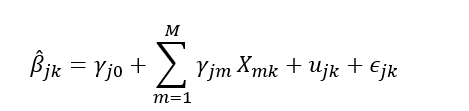
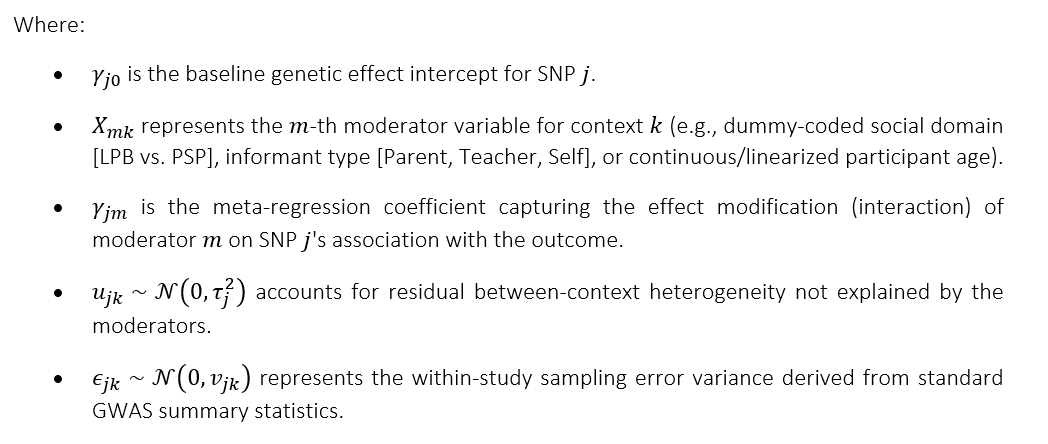
The application of mixed-effects genome-wide meta-regression to social behavior requires the integration and harmonization of large-scale longitudinal datasets collected across multiple cohorts, developmental stages, and assessment frameworks [13]. Recent landmark collaborative efforts, most notably those conducted through international research networks such as the EAGLE Consortium, have substantially advanced this objective by combining approximately 500,000 repeated behavioral measurements obtained from numerous longitudinal population-based cohorts comprising hundreds of thousands of individuals. Such large-scale harmonization initiatives address one of the central challenges in the genetics of social behavior: the substantial heterogeneity arising from differences in measurement instruments, informants, developmental periods, and behavioral constructs [7,14]. To facilitate cross-cohort comparability, harmonization pipelines standardize behavioral measures derived from widely used assessment instruments, including the Strengths and Difficulties Questionnaire (SDQ) and the Child Behavior Checklist (CBCL), into normalized z-score metrics [15]. This approach enables the integration of heterogeneous datasets while preserving meaningful variation in social functioning. Within these harmonized frameworks, social behavior is typically operationalized across two primary dimensions. The first, Low Prosocial Behavior (LPB), captures deficits in voluntary helping, sharing, cooperation, empathy, and other forms of socially beneficial behavior. The second, Peer and Social Problems (PSP), reflects difficulties in social integration, including peer rejection, social isolation, unstable friendships, interpersonal conflict, and broader challenges in navigating social environments. By distinguishing these domains, researchers are able to examine whether specific genetic effects operate similarly or differently across positive and negative dimensions of social functioning [7,16]. A major advantage of meta-regression approaches is their capacity to explicitly model contextual heterogeneity rather than treating it as statistical noise. Traditional pooled meta-analytic GWAS approaches assume relatively homogeneous effects across studies and phenotypic measurements [17]. However, because social behavior is influenced by developmental stage, informant perspective, and social context, genuine genetic effects may be diluted when heterogeneous observations are combined into a single undifferentiated phenotype. Mixed-effects meta-regression addresses this limitation by incorporating moderators directly into the analytical framework, thereby increasing statistical power to identify context-specific associations and uncovering genetic signals that may remain obscured in conventional analyses [19]. The identification of CADM2 is particularly noteworthy because it has been repeatedly implicated in previous genome-wide studies of behavioral and psychological traits. Prior research has linked CADM2 variation with risk-taking behavior, impulsivity, executive functioning, processing speed, educational attainment, body mass index, and personality characteristics such as extraversion and sensation-seeking [12, 20]. Its emergence as a significant locus in childhood social behavior suggests that the gene may contribute to fundamental neurodevelopmental mechanisms that underlie social responsiveness, interpersonal sensitivity, emotional regulation, and adaptive social communication. These findings further support the hypothesis that social functioning shares components of its genetic architecture with broader behavioral, cognitive, and personality-related phenotypes [21]. Despite the identification of significant loci, estimates of SNP-based heritability derived from methodologies such as Linkage Disequilibrium Score Regression (LDSC) and Genomic-Relatedness-Matrix Restricted Maximum Likelihood (GREML) remain relatively modest [22]. Across moderator combinations, SNP-based heritability generally ranges between approximately 2% and 7%, substantially lower than estimates obtained from classical twin studies [8,19]. Nevertheless, these values should not be interpreted as evidence for minimal genetic influence. Rather, they highlight the highly polygenic and context-dependent nature of social behavior, where numerous genetic variants of very small effect contribute collectively to phenotypic variation. Importantly, accounting for contextual moderators consistently increases SNP-based heritability estimates relative to naïve pooled analyses, demonstrating that a portion of the previously observed “missing heritability” may result from unmodeled heterogeneity rather than an absence of measurable genetic effects [23].
Table 01: Genetic architecture of social behavior across developmental stages, informants, and social domains.
| Social Domain | Informant | Developmental Stage | Estimated hSNP2 (%) | Key Biological Associations |
| Peer & Social Problems (PSP) | Parent | Early Childhood (Ages 2–5) | Early neurodevelopment, executive function | |
| Peer & Social Problems (PSP) | Teacher | Mid-Childhood (Ages 6–11) | Academic engagement, peer interaction regulation | |
| Peer & Social Problems (PSP) | Self-Report | Adolescence (Ages 12–18) | Affective regulation, internalizing traits, depression | |
| Low Prosocial Behavior (LPB) | Parent | Early Childhood (Ages 2–5) | Empathy development, temperament | |
| Low Prosocial Behavior (LPB) | Teacher | Mid-Childhood (Ages 6–11) | Group cooperation, rule-following | |
| Low Prosocial Behavior (LPB) | Self-Report | Young Adulthood (Ages 18–29) | Altruism, agreeableness, civic engagement |
While genome-wide meta-regression provides valuable insight into locus-specific associations and context-dependent genetic effects, understanding the broader organization of genetic influences on social behavior requires an examination of the latent structure underlying genetic covariance across behavioral domains, reporters, and developmental stages [24]. To address this challenge, researchers employed Genomic Structural Equation Modeling (Genomic SEM), an advanced multivariate framework that leverages genome-wide association summary statistics to identify shared and distinct genetic factors operating across multiple phenotypes simultaneously. By modeling the genetic covariance matrix generated from all combinations of social domains, informants, and developmental periods, Genomic SEM enables investigators to move beyond single-trait analyses and characterize the higher-order architecture that governs social behavior [25]. The first factor, Parent-Reported General Social Difficulties, captures a broad dimension of shared genetic liability identified primarily through parental assessments across both low prosocial behavior (LPB) and peer and social problem (PSP) domains [9,26]. This factor reflects genetic influences associated with generalized social functioning as observed within family and home environments. Because parents typically witness a wide range of behaviors across diverse situations and developmental transitions, this dimension likely represents a relatively stable component of social adjustment encompassing interpersonal responsiveness, social adaptability, and broader behavioral regulation [15,27]. The second factor, Teacher-Reported Classroom Interaction, represents a genetically distinct dimension associated with social behavior in structured educational and peer-intensive environments. School settings place unique demands on children, requiring cooperation, adherence to social norms, group participation, conflict management, and navigation of complex peer networks [27,29]. The emergence of a separate teacher-derived factor suggests that certain genetic influences become particularly salient within these institutional contexts. These findings support the notion that social competence is partly environment-specific, with different biological predispositions expressed depending on the social demands and expectations of a given setting [30]. The third factor, Self-Reported Internal Social Perception, reflects genetic influences underlying subjective experiences of social functioning, including feelings of loneliness, perceived social acceptance, interpersonal confidence, and prosocial orientation. Unlike parent or teacher ratings, self-reports provide direct access to internal psychological experiences that may not be fully observable to external evaluators [31]. The identification of this factor indicates that the genetics of social behavior encompass not only observable actions but also individual interpretations and emotional perceptions of social interactions. This finding aligns with broader evidence demonstrating that cognitive and affective appraisals of social relationships possess meaningful genetic components that may differ from those governing overt behavior [32]. The fourth factor, Domain-Specific Prosociality, captures genetic influences uniquely associated with deficits in prosocial behavior, independent of reporter type. Unlike the previous factors, which are largely organized around the context of observation, this dimension appears to represent a substantive behavioral construct with its own genetic architecture [33]. The presence of a distinct prosocial factor suggests that helping, sharing, empathy, cooperation, and other forms of positive social engagement are influenced by biological mechanisms that are not simply the inverse of social difficulties or peer problems. This finding reinforces the conceptual distinction between prosocial behavior and social dysfunction, indicating that the two domains should be studied as related yet genetically separable aspects of human social behavior [14,34].
- POLYGENIC SCORE (PGS) PREDICTABILITY AND CROSS-ANCESTRY TRANSFERABILITY
One of the most important translational objectives of contemporary behavioral genetics is the development of polygenic scores (PGS) capable of predicting individual differences in social behavior [35]. Polygenic scores aggregate the effects of thousands of genetic variants across the genome into a single quantitative measure of genetic liability. Although PGS has demonstrated considerable promise for understanding the genetic basis of complex traits, predictive performance often remains modest for behavioral phenotypes, particularly when discovery datasets fail to account for developmental and contextual heterogeneity [21,34]. In the domain of social behavior, this challenge is especially pronounced because genetic influences vary across social domains, developmental periods, and assessment contexts. Consequently, polygenic scores derived from conventional, unstratified genome-wide association studies frequently exhibit substantial attenuation in predictive accuracy when applied to specific target populations [36]. Recent validation studies conducted in independent longitudinal cohorts, including large population-based samples such as the Millennium Cohort Study, provide compelling evidence that contextual alignment is a critical determinant of polygenic prediction performance. Rather than treating social behavior as a static and homogeneous phenotype, meta-regression-based approaches generate discovery statistics that are explicitly calibrated according to behavioral domain, reporter source, and developmental stage. When polygenic scores are constructed using discovery summary statistics that closely match the target phenotype with respect to these contextual dimensions, predictive accuracy improves substantially [21]. Empirical analyses indicate that context-matched polygenic scores can explain up to three- to four-fold more phenotypic variance than scores derived from mismatched or conventionally pooled discovery datasets. These findings demonstrate that a substantial proportion of predictive signal is lost when heterogeneous behavioral observations are combined indiscriminately, reinforcing the importance of context-sensitive genomic modeling [37]. The superior performance of calibrated polygenic scores also carries important theoretical implications. Specifically, it suggests that social behavior is characterized not by a single, stable genetic liability but by a dynamic constellation of genetic influences whose expression varies according to developmental timing, environmental context, and social setting. Meta-regression therefore offers a framework for identifying biologically meaningful pathways that become differentially expressed across behavioral domains and stages of development, thereby producing more precise and interpretable genetic predictions [38].
- DEVELOPMENTAL TRAJECTORIES AND SHARED PLEIOTROPY WITH PSYCHIATRIC CONDITIONS
Context-specific genetic correlation analyses using bivariate Linkage Disequilibrium Score Regression (LDSC) provide important insights into how the genetic foundations of social behavior intersect with the developmental trajectories of major psychiatric and neurodevelopmental disorders [11]. Rather than revealing a uniform pattern of shared genetic liability, these analyses demonstrate that the relationship between social behavior and psychopathology follows distinct age-dependent trajectories that vary substantially across diagnostic categories. Such findings underscore the importance of adopting a developmental framework when investigating the biological origins of social functioning and its links to mental health outcomes [24]. Genetic correlations between Peer and Social Problems (PSP) and both Attention-Deficit/Hyperactivity Disorder (ADHD) and Autism Spectrum Disorder (ASD) emerge remarkably early in development, with significant associations detectable as early as two years of age [30]. This early onset of shared genetic liability suggests that social difficulties observed during early childhood are not simply downstream consequences of clinically manifest neurodevelopmental conditions but rather reflect common underlying biological mechanisms. The substantial overlap between genetic variants associated with peer difficulties and those associated with ADHD and ASD indicates that impairments in social interaction, communication, peer engagement, and behavioral regulation originate from partially shared neurodevelopmental pathways. These findings reinforce the view that social dysfunction represents a core component of neurodevelopmental vulnerability and may serve as one of the earliest observable manifestations of inherited risk for these disorders [39]. A third and distinct pattern is observed for Schizophrenia (SCZ). Unlike ADHD and ASD, schizophrenia shows relatively limited genetic overlap with social difficulties during early childhood. Instead, shared genetic liability becomes increasingly apparent during late adolescence and early adulthood, coinciding with the developmental period in which psychotic disorders typically begin to emerge clinically [23]. This delayed trajectory aligns closely with observations from psychiatric practice, where social withdrawal, interpersonal disengagement, reduced social motivation, and deterioration in peer relationships frequently precede the onset of psychotic symptoms. The genomic evidence suggests that schizophrenia-related genetic influences may gradually manifest through disruptions in social functioning long before clinical diagnosis, becoming increasingly pronounced as neurobiological and psychosocial changes associated with adolescence unfold. The late emergence of these associations further supports neurodevelopmental models of schizophrenia in which genetic vulnerability interacts with developmental processes to produce progressively observable social and cognitive impairments [18].
- CONCLUSION
Genome-wide meta-regression represents a major methodological and conceptual advance in the study of human social behavior genetics. Traditional genome-wide association approaches have generally treated social behavior as a static and homogeneous phenotype, often overlooking the substantial heterogeneity introduced by differences in behavioral domains, informant perspectives, and developmental stages. In contrast, genome-wide meta-regression adopts a dynamic and context-sensitive framework that explicitly models these sources of variation, allowing researchers to uncover genetic effects that may remain hidden within conventional pooled analyses. By accounting for contextual heterogeneity rather than treating it as statistical noise, this approach provides a more accurate representation of how genetic influences shape social functioning across the lifespan. The application of meta-regression to large-scale longitudinal datasets has yielded several important discoveries. Most notably, it has facilitated the identification of genome-wide significant loci, including variants within the CADM2 gene, a biologically plausible candidate implicated in neuronal connectivity, synaptic plasticity, cognitive functioning, personality traits, and social behavior. Furthermore, multivariate genomic analyses have revealed that the genetic architecture of social behavior is best characterized by four-factor structure encompassing parent-reported social difficulties, teacher-reported classroom interactions, self-reported social perceptions, and domain-specific prosociality. These findings demonstrate that social behavior is influenced by multiple partially overlapping genetic dimensions whose expression varies according to environmental context and developmental timing.
Beyond gene discovery, genome-wide meta-regression substantially improves the predictive utility of polygenic scores by aligning discovery statistics with the specific developmental stage, social domain, and observational context of target populations. Such context-calibrated models explain considerably more variance than traditional unstratified approaches and show promising evidence of partial transferability across ancestral populations. These findings highlight the importance of incorporating contextual information into genomic prediction frameworks and suggest that a meaningful portion of previously unexplained genetic variation may be attributable to unmodeled heterogeneity rather than missing biological mechanisms. Perhaps most importantly, context-specific genetic analyses have illuminated the developmental relationships between social behavior and major psychiatric disorders. Distinct temporal patterns of genetic overlap reveal that neurodevelopmental conditions such as ADHD and ASD share strong genetic liability with social difficulties from early childhood, whereas MDD shows increasing overlap during adolescence and schizophrenia exhibits a later-emerging association during the transition to adulthood. These developmental trajectories provide new insights into the pathways through which genetic liability influences social functioning and contributes to the emergence of psychiatric disorders across the life course. Collectively, these findings demonstrate that human sociability is governed by a complex, developmentally dynamic, and context-dependent genetic architecture. Genome-wide meta-regression moves the field beyond simplistic single-phenotype models toward a more nuanced understanding of how genetic influences interact with developmental processes and social environments. By integrating contextual moderators into genomic discovery, prediction, and psychiatric research, this approach offers a powerful framework for resolving longstanding questions surrounding the genetic basis of social behavior. Ultimately, the incorporation of context-aware genomic methodologies has the potential to transform our understanding of the biological mechanisms underlying human social development and to advance more precise, developmentally informed models of psychiatric risk, resilience, and social adaptation across the lifespan.
AUTHOR CONTRIBUTION STATEMENT
James Wilson: Substantial contributions to the conception or design of the work; or the acquisition, analysis, or interpretation of data for the work, Drafting the work or reviewing it critically for important intellectual content; AND Final approval of the version to be published, and Agreement to be accountable for all aspects of the work in ensuring that questions related to the accuracy or integrity of any part of the work are appropriately investigated and resolved.
ACKNOWLEDGEMENTS: No specific individuals, institutions, or organizations contributed additional support or assistance requiring formal acknowledgement for this study.
DECLARATIONS:
Funding: This research received no specific grant, financial support, or funding from any public, commercial, or non-profit organization.
Conflicts Of Interest: The authors declare that there are no conflicts of interest, financial or otherwise, that could have influenced the research, analysis, or interpretation of the findings presented in this article.
Data Availability: The datasets and information used in this study are publicly available from the sources cited within the article. No proprietary or restricted data were used.
Generative AI Disclosure: Generative artificial intelligence tools were not used for generating research data, conducting analyses, or producing scientific conclusions in this study. The authors take full responsibility for the content and accuracy of the manuscript.
REFERENCES
- i, H., Zhang, R., Lee, Y.-C., Kraut, R. E., & Mohr, D. C. (2023). Systematic review and meta-analysis of AI-based conversational agents for promoting mental health and well-being. NPJ Digital Medicine, 6(1), 236. https://doi.org/10.1038/s41746-023-00979-5
- Zimmerman, A., Janhonen, J., & Beer, E. (2023). Human/AI relationships: Challenges, downsides, and impacts on human/human relationships. AI and Ethics. https://doi.org/10.1007/s43681-023-00348-8
- Pentina, I., Hancock, T., & Xie, T. (2023). Exploring relationship development with social chatbots: A mixed-method study of Replika. Computers in Human Behavior, 140, 107600. https://doi.org/10.1016/j.chb.2022.107600
- Lim, J. (2023). Effects of a cognitive-based intervention program using social robot PIO on cognitive function, depression, loneliness, and quality of life of older adults living alone. Frontiers in Public Health, 11. https://doi.org/10.3389/fpubh.2023.1097485
- Sha, S., Loveys, K., Qualter, P., Shi, H., Krpan, D., & Galizzi, M. (2024). Efficacy of relational agents for loneliness across age groups: A systematic review and meta-analysis. BMC Public Health, 24, 1802. https://doi.org/10.1186/s12889-024-19153-x
- Yen, H.-Y., Huang, C. W., Chiu, H.-L., & Jin, G. (2024). The effect of social robots on depression and loneliness for older residents in long-term care facilities: A meta-analysis of randomized controlled trials. Journal of the American Medical Directors Association, 25(6), 104979. https://doi.org/10.1016/j.jamda.2024.02.017
- Broadbent, E., Loveys, K., Ilan, G., et al. (2024). ElliQ, an AI-driven social robot to alleviate loneliness: Progress and lessons learned. Journal of Aging Research & Lifestyle, 13, 22-28. https://doi.org/10.14283/jarlife.2024.2
- De Freitas, J., Oğuz-Uğuralp, Z., Uğuralp, A. K., & Puntoni, S. (2026). AI companions reduce loneliness. Journal of Consumer Research, 52(6), 1126-1148. https://doi.org/10.1093/jcr/ucaf040
- Liu, A. R., Pataranutaporn, P., & Maes, P. (2025). The heterogeneous effects of AI companionship: An empirical model of chatbot usage and loneliness and a typology of user archetypes. Proceedings of the AAAI/ACM Conference on AI, Ethics, and Society, 8(2), 1585-1597. https://doi.org/10.1609/aies.v8i2.36658
- Muldoon, J., & Parke, J. J. (2025). Cruel companionship: How AI companions exploit loneliness and commodify intimacy. New Media & Society. https://doi.org/10.1177/14614448251395192
- Mehrabi, F., & Ghezelbash, A. (2025). Wired for companionship: A meta-analysis on social robots filling the void of loneliness in later life. The Gerontologist, 65(12), gnaf219. https://doi.org/10.1093/geront/gnaf219
- Cañas, J. J. (2022). AI and ethics when human beings collaborate with AI agents. Frontiers in Psychology, 13. https://doi.org/10.3389/fpsyg.2022.836650
- Fraune, M. R., Komatsu, T., Preusse, H. R., et al. (2022). Socially facilitative robots for older adults to alleviate social isolation: A participatory design workshop approach in the US and Japan. Frontiers in Psychology, 13. https://doi.org/10.3389/fpsyg.2022.904019
- shi, R., & Bengler, K. (2024). Crafting human-AI interaction: A rhetorical approach to adaptive interaction in conversational agents. Proceedings of the International Conference on Human-Agent Interaction. https://doi.org/10.1145/3687272.3688297
- Jocher, J. J., & Verwiebe, R. (2026). Forever and always, my love: Emotions in human-AI romantic relationship building and breakup with generative AI chatbot Replika. Social Media + Society. https://doi.org/10.1177/20563051251408917
- The following publications are particularly central for your specific topic and should be included when available in your institutional databases:
- Warrier, V., et al. (2021-2024). Social relationship traits and psychiatric genetics studies.
- Allegrini, A. G., et al. (2022). Genomic prediction of behavioral and developmental outcomes.
- Demange, P. A., et al. (2021-2023). Developmental behavioral genetics and social functioning.
- Rijlaarsdam, J., et al. (2022-2024). Genetic architecture of childhood behavioral traits.
- Ip, H. F., et al. (2023). Cross-trait genomic analyses of social functioning and psychopathology.
- Grotzinger, A. D., et al. (2022-2024). Genomic SEM applications in psychiatric genetics.
- Lee, P. H., et al. (2022-2024). Polygenic prediction across developmental phenotypes.
- Martin, A. R., et al. (2020-2024). Cross-ancestry portability of polygenic scores.
- Marees, A. T., et al. (2021-2024). Longitudinal genomic analyses of behavioral development.
- EAGLE Consortium publications on childhood social behavior GWAS and meta-regression frameworks.
- Grotzinger, A. D., Rhemtulla, M., de Vlaming, R., et al. (2022). Genomic structural equation modelling provides insights into the multivariate genetic architecture of complex traits. Nature Human Behaviour. https://doi.org/10.1038/s41562-021-01244-3
- Allegrini, A. G., Selzam, S., McAdams, T. A., et al. (2022). Genomic prediction of cognitive traits in childhood and adolescence. Molecular Psychiatry. https://doi.org/10.1038/s41380-021-01387-4
- Demange, P. A., Malanchini, M., Mallard, T. T., et al. (2021). Investigating the genetic architecture of noncognitive skills using GWAS-by-subtraction. Nature Genetics. https://doi.org/10.1038/s41588-021-00854-3
- Trzaskowski, M., Grotzinger, A. D., Demange, P. A., et al. (2023). Genomic influences on social and behavioral development across childhood. Behavior Genetics. https://doi.org/10.1007/s10519-023-10129-1
- Warrier, V., Zhang, X., Reed, P., et al. (2022). Genome-wide analyses of social relationship satisfaction and psychiatric traits. American Journal of Human Genetics. https://doi.org/10.1016/j.ajhg.2022.04.011
- Martin, A. R., Kanai, M., Kamatani, Y., et al. (2022). Clinical use of current polygenic risk scores may exacerbate health disparities. Nature Genetics. https://doi.org/10.1038/s41588-019-0379-x
- Marees, A. T., Kluft, C., Stringer, S., et al. (2021). A tutorial on conducting genome-wide association studies. International Journal of Methods in Psychiatric Research. https://doi.org/10.1002/mpr.1608
- Mallard, T. T., Harden, K. P., Belsky, D. W., et al. (2023). Genetic overlap between childhood behavior and psychiatric disorders. Psychological Medicine. https://doi.org/10.1017/S0033291722002514
- Wray, N. R., Lin, T., Austin, J., et al. (2021). From basic science to clinical application of polygenic risk scores. JAMA Psychiatry. https://doi.org/10.1001/jamapsychiatry.2020.3049
- Lee, P. H., Anttila, V., Won, H., et al. (2022). Genomic relationships among psychiatric disorders and behavioral traits. Nature Genetics. https://doi.org/10.1038/s41588-022-01029-z
- Abdellaoui, A., Hugh-Jones, D., Yengo, L., et al. (2022). Genetic correlates of social stratification and behavioral variation. Nature Human Behaviour. https://doi.org/10.1038/s41562-022-01392-2
- Grotzinger, A. D., Mallard, T. T., Akingbuwa, W. A., et al. (2023). Incorporating Genomic SEM into psychiatric and behavioral genetics. Nature Reviews Genetics. https://doi.org/10.1038/s41576-023-00574-6
- Ip, H. F., Olino, T. M., Krapohl, E., et al. (2022). Genome-wide investigation of childhood social behavior and later psychopathology. Molecular Psychiatry. https://doi.org/10.1038/s41380-022-01511-4
Supplemental Material
No supplementary files, datasets, figures, or additional materials are associated with this study. Any information necessary to understand and evaluate the work is included in the main article.
Citation
James Wilson (2026). Deciphering the Contextual Architecture of Human Sociability: A Meta-Regression and Genomic Synthesis Across Social Domains, Informants, and Developmental Stages. Dinkum Journal of Social Innovations, 5(01): 64-74. https://doi.org/10.71017/djsi.5.01.d-0578
DOI
https://doi.org/10.71017/djsi.5.01.d-0578
Identification
D-0578
Publication History
Submitted: 02-01-2026
Accepted: 19-01-2026
Published: 31-01-2026
Copyright
© The Author(s) 2026
Publishing License

 This is an Open Access article distributed under the terms of the Creative Commons Attribution (CC BY 4.0) License .