
Vol. 5 No.04 (2026) | Page: 256-273 |Original Article 
Factors Influencing Male Participation in Maternal Health Care Services Among Couples in Sunyani East Municipality
Clement Oppong Berkoh 1*
-
- Teaching Assistant, Nursing and Midwifery Training College, Dunkwa-on-Offin, Ghana.
 clementoppongberkoh391@gmail.com




ABSTRACT
Background: Men’s active involvement in their female partners’ maternal healthcare needs is known as male participation. This involves joining the women to the hospital for Antenatal Care (ANC), birth, and Postnatal Care (PNC), as well as offering them emotional, physical, and financial support. The term “maternal health” refers to the well-being of women during pregnancy, childbirth, and the postpartum period.
Objective: This study was to determine the factors that affect men’s use of maternal healthcare services among couples in the Sunyani east municipality.
Methods: Data from 246 men, 18 years of age and older, who were married or cohabiting with a woman of reproductive age and had ever sought out maternal healthcare services were gathered using a cross-sectional study methodology.
Results: The findings showed that male involvement in maternal healthcare services was significantly influenced by age, education level, occupation, income, and cultural beliefs in addition to awareness of maternal health. Men were more likely to use maternal healthcare services if they had greater incomes, educational backgrounds, and maternal health awareness.
Conclusion: According to the study, there is a need for focused initiatives that overcome cultural norms and encourage male participation in maternal healthcare services.
Keywords: maternal health, antenatal care, ANC, Sunyani
Key points:
- Which socioeconomic and cultural factors influence men’s participation in maternal healthcare services in Sunyani East Municipality?
- Higher income, education, and maternal health awareness are associated with greater male participation in maternal healthcare services.
- Targeted education and culturally sensitive interventions can strengthen men’s involvement in antenatal, childbirth, and postnatal care.
- INTRODUCTION
Men’s active involvement in their female partners’ maternal healthcare needs is known as male participation. This involves joining the women to the hospital for Antenatal Care (ANC), birth, and Postnatal Care (PNC), as well as offering them emotional, physical, and financial support [1]. The term “maternal health” refers to the well-being of women during pregnancy, childbirth, and the postpartum period [2]. Antenatal care (ANC), delivery care, and postnatal care (PNC) services are all related to maternal health [3]. Hence maternal healthcare services are care provided by skilled healthcare providers to pregnant women to ensure the best health conditions for both mother and baby during pregnancy, delivery and postpartum [4,1].In the past, men were perceived as obstacles rather than as a part of the solution in prenatal and postpartum care services [5,2]. Women have been the main target of crucial interventions and services to advance sexual and reproductive health, including care during pregnancy, childbirth, and postpartum. Women frequently serve as the only clients for reproductive health (RH) treatments like family planning, abortion, Sexually Transmitted Diseases (STDs) treatment, and management of infertility, among others. Women’s reproductive processes, including pregnancy and childbirth, are essential to the continuation of our species yet tend to come with risks that they should be shielded against [6]. This duty necessitates the full participation of the entire family, particularly the spouse, the neighbourhood, and the government. On a worldwide scale, there has been a shared awareness that men’s participation in reproductive health policy and service delivery has significant advantages for both men and women [7]. Recognizing the crucial role of males in reproductive health was made possible by the International Conference on Population and Development (ICPD), which took place in Cairo in 1994. In 1995, the Fourth Conference of Women in Beijing and the ICPD both raised awareness of men’s reproductive responsibility on a global scale [8,2]. Resolutions from both summits supported men’s shared accountability, advocated their active participation in parental responsibility, and encouraged their sexual and reproductive health behaviour [9]. Ghana, a patriarchal nation, views pregnancy and childbirth difficulties as primarily a woman’s responsibility [10]. At the home and global levels, men are largely regarded as the leaders and decision-makers [11]. In developing nations, the majority of sexual and reproductive health services, such as care and assistance during pregnancy and childbirth and after birth are directed toward women [12]. Despite calls for males to participate in maternity care, their participation is not well recognized [13]. Some research from Africa claimed that men influence women’s decisions to seek maternal health care. For instance, research in Kano, Nigeria, found that 17.2% of women skipped monthly ANC sessions because of spouse denial [14,11]. The state of Ghana’s reproductive health is far from ideal, even though it like many other African nations, has ratified international conventions on sexual and reproductive health. Attendance of at least four ANC visits is 78.2% of the time, whereas at least one visit is 97% of the time [15]. The maternal mortality ratio (MMR) continues to hover at unacceptably high levels, with several authorities providing conflicting and unsettling data. According to estimations from the Ghana Maternal Health Survey and WHO country statistics, the maternal mortality ratio, MMR for 2017 was estimated to be 580/100,000 live births, 230/100,000 live births, and 451/100,000 live births, respectively. In clear contrast, Egypt had an maternal mortality ratio of 59per 100,000 live births in 2006 and rates of 27 and 32 per 1000 live births for infant mortality and under-five mortality, respectively [16,2].The purpose of this study is to investigate the factors that influence male participation in maternal health care services among couples in a Sunyani east municipality. The outcome of this study would be enlighten on the factors influencing male participation in maternal health care services; antenatal, delivery and postnatal care among couples in Sunyani east municipality and this will help the Sunyani east municipal health directorate to design the appropriate strategies to improve male participation/ involvement in maternal health care service in the municipality.
- MATERIALS AND METHODS
The study used a quantitative descriptive cross-sectional research design to collect data from men in the municipality. The study was conducted in Bono regional hospital and Sunyani municipal hospital, all in Sunyani east municipality. The municipality has a total land area of 829.3 square kilometres (320.1square miles). The municipality falls within the wet semi-equatorial climatic zone of Ghana. The mean monthly temperatures vary between 23ºC and 33ºC with the lowest around August and the highest being observed around March and April [17].
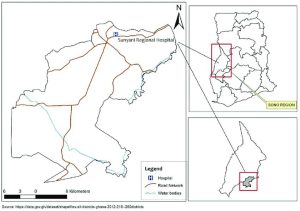
Figure 01: Location of Sunyani east municipality
The target population for this study was men in the municipality whose female partner has ever sought for maternal healthcare services in the municipality. The inclusion criteria were participants must have a partner who has ever sought for maternal healthcare services from the health facilities in the municipality, participants must have had a child in the last five years and participants must be residents of the municipality. The exclusion criteria were participants who does not have a partner, participants who have not had a child in the last five years and participants who are not residents of the municipality. The sample size for this study was determined using the Cochran’s sample size formula for calculating sample size for a cross-sectional study. The sample size was calculated based on the proportion of men who participate in maternal health care services in the municipality, which is estimated to be 20%. A margin of error of 5% and a confidence level of 95% will be used which is an ideal sample size for a desired level of precision because it safe for sample size for a large population of unknown size, it is recommended to be used for studies with infinite populations [18].
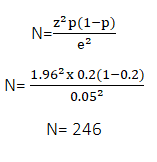
N is the sample size
e: desired level of precision, the margin of error which is 5% (0.05)
p: the fraction of the population (as percentage) that displays the attribute that 20% (0.2)
z: the z-value, extracted from a z-table which is 1.96 using confidence level of 95%
The calculated sample size was 246, a purposive sampling technique was used to select participants through their partners by networking the researcher to their partners. Participants were purposively selected as those participants partners seek maternal healthcare services from the Bono regional hospital and Sunyani municipal hospital were asked to come with their partners on their next visit on some specific dates. Questionnaires were used for collecting data from the research participants. The questionnaire was used with information about the research study and employed close-ended questions. The questionnaire was pre-tested among 20 men who partners have attended maternal health care services in a similar health facility (SDA hospital in Sunyani) who provide maternal healthcare services but not included in the study sample. The feedback from the pretest will be used to improve the questionnaire’s clarity and validity.Data collected was analysed using Statistical Package for Social Sciences version 26. Descriptive statistics was used to analyse the demographic characteristics of the respondents. Chi-square test was used to determine the association between the attitudes and the level of their participation and to identify the factors that significantly influence male participation in maternal health care services. Logistic regression analysis was used to analyse the socio demographic variables and attitude level of men The level of significance will be set at probability value < 0.05.
- RESULTS & DISCUSSION
3.1 Socio-demographic characteristics
The socio-demographic characteristics provide a clear understanding of the study participants. Data collected on their age, educational level, religion, occupation and number of children. Table 01 shows a detailed presentation of the results. Majority (48.4%) of the respondents were aged between 26 and 35 years old, some (41.9%) of the respondents were aged 36 years and beyond and (10.1%) of them were between the ages of 18-25 years. The least age group was from 18-25 years, and they were 25 in number with a percentage of 10.1. With regards to their educational background, majority (41.5%) of the respondents indicated they have tertiary education, nearly one-third (30.5%) of the participants had secondary education about (22%) had basic education whilst few (5.7%) had no formal education. Almost all (95.9%) of the respondents were Christians with a few (4.1%) being Muslims. With respect to the participants’ occupation, majority (40.2%) of the respondents were unemployed, about one-third (34.1%) were skilled and (3.3%) were unskilled whilst (22.4%) were professional workers. The proportion of men who had between 1 and 3 children were (98.4%) whilst very few (1.6%) of the respondents had 4-7 children.
Table 01: Socio-demographic characteristics
| Statements | Frequency | Percentage % | |
| What is your age in years? | 18-25 | 25 | 10.1% |
| 26-35 | 119 | 48.4% | |
| 36 and beyond | 102 | 41.5% | |
| What is your educational background | No formal education | 14 | 5.6% |
| Basic education | 54 | 22.0% | |
| Secondary | 75 | 30.5% | |
| Tertiary | 103 | 41.9% | |
| Religious affiliation | Christianity | 236 | 95.9% |
| Islam | 10 | 4.1% | |
| Traditional | 0 | 0.0% | |
| Others | 0 | 0.0% | |
| Occupation | Unemployed | 99 | 40.2% |
| Skilled | 84 | 34.1% | |
| Unskilled | 8 | 3.3% | |
| Professional | 55 | 22.4% | |
| Number of children | 1-3 | 242 | 98.4% |
| 4-7 | 4 | 1.6% | |
| 8 and above | 0 | 0.0% | |
| N/A | 0 | 0.0% | |
Knowledge Level of Men on Maternal Health Care Services
Participants were asked if they have heard of the term maternal health service before and the results is shown in figure 1 below. Almost all (98.4) of the respondents indicated that they have heard of the term of maternal health service before.
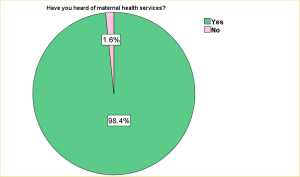
Figure 02: Knowledge Level of Men on Maternal Health Care Services
With respect to those who have heard of the term before, majority (39.5%) stated the media to be the main source of information on maternal health service followed by other sources (30%), health personnel (21%) and through personnel research (9.5%). The result is shown in figure 02.
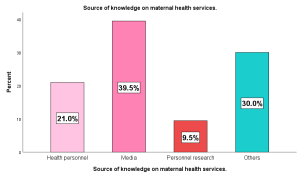
Figure 03: Source of knowledge on maternal services
As to whether the respondents had ever heard of antenatal care or not, all (100%) the respondents indicated clearly that they have ever heard of antenatal care before as shown in figure 03.
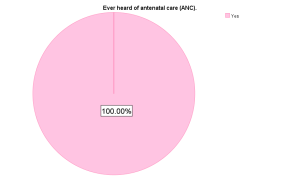
Figure 04: Ever heard of antenatal care
To further assess the respondents’ level of knowledge on maternal health service into details, seven items on the knowledge dimension was created by adding for each respondent, the scores of knowledges on pregnant women’ s reproductive health needs. This was measured by the total number of positive answers to their various awareness. The total score was calculated by adding up the points obtained for the corresponding questions and was expressed as mean with a maximum score of 7 points. Bloom’s cut off point and was used to categorize knowledge level into high and low with a score of ≥ 80% indicating high knowledge and <80% been low knowledge. The mean total score was 6. 3457.The results showed that majority (83.5%) of the respondents had high knowledge level on maternal health service whilst few (16.5%) of the participants exhibited poor knowledge.
Table 02: level of knowledge
| Frequency | Percent | ||
| Low | 40 | 16.5 | |
| High | 203 | 83.5 | |
| Total | 243 | 100.0 | |
Table 03 represents the summary of the responses the respondents indicated with regards to their awareness on maternal health care. More than two-thirds (71.6%) of the respondents rightly stated that maternal health care involves the care of women before, during and after child birth. Almost all (98.8%) of the respondents said maternal health service is important to both the mother and the baby. Almost all (99.2%) of the respondents stated that they have a role to play in maternal health services. As to whether health professionals should involve them in the maternal care activity of your partner, majority (99.2%) of the respondents agreed to that fact whilst few (11.4%) stated the opposite. When they were asked what ANC entails, majority (88.6%) of the males rightly stated taking care of pregnant women and their fetus and also detecting and managing complications before, during and after delivery to be the answer meanwhile, a few (11.4%) of them stated giving drugs and injection to pregnant women to be the response. Almost all (98%) of them indicated that antenatal care provides early detection of mother’s and baby’s abnormality.
Table 03: Summary of the indicators of respondent’s knowledge level
| Statement | Yes (%) | No (%) |
| What is maternal health care services?
General wellbeing of pregnant women/ General wellbeing of women in fertility age |
||
| 69(28.4) | ||
| Health of women during pregnancy, childbirth and postnatal period | 174(71.6) | |
| What is the importance of maternal health services? | ||
| Increase attendance to medical facility/ Promotes family union/ No significance | 80(32.8) | |
| Helps keeps mother and baby healthy and safe | 164(67.2) | |
| What does ANC entails? | ||
| Giving drugs and injection to pregnant women | 28(11.4) | |
| Taking care of pregnant women and their fetus/ Detecting and managing complications | 218(88.6) | |
| Is maternal health service important to mother and baby? | 242(98.8) | 3(1.2) |
| Do you belief you have a role to play in maternal health services? | 244(99.2) | 2(0.8) |
| Is it important for health professionals to involve you in the maternal care activity of your partner? | 244(99.2) | 2(0.2) |
| Do you belief you have a role to play in maternal health services? | 244(99.2) | 2(0.2) |
| Antenatal care provides early detection of mother’s and baby’s abnormality | 241(98.0) | 5(2.0) |
3.2 Discussion of Results on Knowledge Level of Men on Maternal Health Care Services
In this study, men’s knowledge on maternal health care services was found to be high. This agrees with a study which revealed the overall men’s knowledge on maternal care to be satisfactory [19]. Moreover, a study Bangladash reported a high knowledge of men on maternal health care services. Contrary to the findings of this study, a study conducted in Ethiopia found that men had poor knowledge of maternal healthcare services [20]. Similar study conducted in Nepal found that men had limited knowledge of postpartum care. The study also found that men had limited knowledge of the importance of exclusive breastfeeding and the prevention of postpartum complications [21]. A study in Nigeria found that men had limited knowledge of delivery and postpartum care [11,22]. Furthermore, a study conducted in Sekondi in the Western region of Ghana found that men had limited knowledge of maternal healthcare services [23]. In Ghana, a cross-sectional design was employed to conduct a study in Sekondi in the Western region showed that men had limited knowledge of maternal healthcare services and what goes into it but there was high male participation at the Antenatal session of maternal healthcare services as compares to delivery and post-natal [24]. According to [19,25], a study conducted in Anomabo in the central region of Ghana found that men that accompanied their partners to prenatal care, delivery, and postpartum care services in proportions of 35%, 44%, and 20%, respectively in such low percentages due to their poor knowledge on the need for participation and the kinds of services provided.
3.3 Males Attitudes Towards Maternal Healthcare Services
The eleven items on the attitude dimension were assed using a five-point Likert scale ranging from 1-5 (1 = strongly disagree, 2 = disagree, 3 = neutral, 4 = agree and 5 = strongly agree). Bloom’s cut off point was used to categorize attitude into high and low attitude level with a score of ≥ 80% indicating high attitude and <80% expressing low attitude level. The result is illustrated in figure 05 below.The result shows that more than half (51.6%) of the respondents had a high attitude level. On the other side, less than half (48.4%) of the respondents showed a low attitude level.
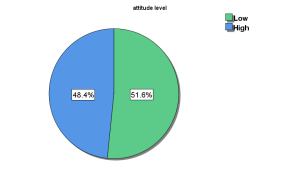
Figure 05: Had a high attitude level
Table 04 shows the awareness of the attitude of men of the various dimensions into details. Majority (41.1%) of the respondents strongly agreed that men must involve themselves in choosing the maternal health facility to be used by your partner. More than halve (55.7%) of the males said men must escort their partners to the antenatal clinic. Less than half (46.3%) stated that men must help during their partner’s pregnancy with any of their children. Moreover, about (42.3%) of the respondents strongly agreed that men must willfully accompany their partners when an emergency arises. About one-third (35.8%) strongly agreed that Men must participate in labor and delivery, majority (61%) reported that financial constraints to be a barrier to participation in maternal health. A little over halve (52.4%) of the participants strongly agreed that Involvement in antenatal care will give them more knowledge and to seek obstetric care for your wife. More than half (58.1%) of the respondents reported that they only go to ANC if requested by health care provider. Majority (56.5%) of the respondents strongly agreed that they are only responsible in taking decision about where and when to seek antenatal care. Less than half (42.3%) of the participants indicated that their women spend so much time at maternal health facilities which deters them from accompanying the women for care. Nearly two-thirds (65%) of the respondents strongly agreed that their partners accept their involvement in maternal health issues
Table 04: Attitude of men towards maternal healthcare services
| Statements | SD | D | N | A | SA | |
| Men must involve themselves in choosing the maternal health facility to be used by your partner | 44 (17.9%) | 5 (2.0%) | 52 (21.1%) | 44(17.9%) | 101(41.1%) | |
| Men must escort their partners to the antenatal clinic | 23(9.3%) | 5(2.0%) | 11(4.5%) | 70(28.5%) | 137(55.7%) | |
| Men must help during their partner’s pregnancy with any of your children | 51 (20.7%) | 14(5.7%) | 7(2.8%) | 60(24.4%) | 114(46.3%) | |
| Men must wilfully accompany their partners when an emergency arises. | 44(17.9%) | 22(8.9%) | 23(9.3%) | 53(21.5%) | 104(42.3%) | |
| Men must participate in labor and delivery | 68(27.6%) | 37(15.0%) | 44(17.9%) | 9(3.7%) | 88(35.8%) | |
| Financial constraints impede your participation in maternal health. | 3(1.2%) | 35(14.2%) | 17(6.9%) | 41(16.7%) | 150(61.0%) | |
| Involvement in antenatal care will give you more knowledge and to seek obstetric care for your wife | 28(11.4%) | 22(8.9%) | 32(13.0%) | 35(14.4%) | 129(52.4%) | |
| Men only go to ANC if requested by health care provider. | 39(15.9%) | 30(12.2%) | 27(11.0%) | 7(2.8%) | 143(58.1%) | |
| Husband is only responsible in taking decision about where and when to seek antenatal care. | 16(6.5%) | 50(20.3%) | 29(11.8%) | 12(4.9%) | 139(56.5%) | |
| Women spend so much time at maternal health facilities which deters men from accompanying them. | 18(7.3%) | 52(21.1%) | 25(10.2%) | 47(19.1%) | 104(42.3%) | |
| Your partner accepts your involvement in maternal health issues | 0 (0.0%) | 30(12.2%) | 32(13.0%) | 24(9.8%) | 160(65.0%) | |
In the table, SD= strongly disagree; D= disagree; N= neutral; A=agree; SA= strongly agree
3.4 Discussion of results on Males Attitudes Towards Maternal Healthcare Services
The findings of this study further showed that men have a poor attitude towards maternal health care services despite their high knowledge level. This is consistent with findings from a study which revealed that majority of men had negative attitude towards maternal healthcare [26]. Similarly, in a different study, the level of awareness of men about maternal heath was high, but their involvement in giving care was poor and only about half of them had good attitude towards maternal health care [27].On the other hand, a study conducted in Mumbai revealed that majority of the husbands had a positive attitude towards maternal healthcare services [28]. Moreover, a study in Nigeria revealed a positive attitude towards maternal healthcare [29].In Ghana, according to [30], most expectant men are too shy and uneasy to be in the predominantly female antenatal care and maternity units, in a study conducted in Hohoe in the Volta region of Ghana.Another study conducted in Anomabo in the Central region of Ghana found that men’s attitudes towards maternal healthcare were poor due to lack of knowledge on need for their participation and poor male friendly environment at units where maternal healthcare services [11,17].
3.5 Factors Influencing Maternal Health Care Services
Respondents were asked about the perceived factors that may influence patients’ right practice and the results are shown in table 05. Factors that respondents indicated to influence maternal health care services were; dramatization of men in their involvement in maternal health care (100%), recognition of the significance of men’s involvement (100%), advocacy for men’s involvement in maternal health (100%), timing schedule of the antenatal service (98%), type of marriage practice (98.4%), prohibitive cultural norms (97.6%), antenatal clinic dominance by female staff (97.2%), little knowledge about the services (69.5%) and financial constraints (54.1%). However, more than half (57.3%) of the respondents reported that distance to healthcare facility is not a barrier to their involvement in maternal health care services.
Table 05: Factors That Facilitate or Hinder Male Participation in Maternal Healthcare Services
| Variables | Frequency | Percent % | |
| Does timing schedule of the antenatal service prevent you from accompanying your wife to the clinic? | Yes | 241 | 98.0% |
| No | 5 | 2.0% | |
| Do you see any benefit of participating in antenatal care programs? | Yes | 239 | 97.2% |
| No | 7 | 2.8% | |
| Does antenatal clinic dominance by female staff prevents you from participating in ANC? | Yes | 239 | 97.2% |
| No | 7 | 2.8% | |
| Do you refuse attending ANC with your partner due to little knowledge about the services? | Yes | 171 | 69.5% |
| No | 75 | 30.5% | |
| Does your type of marriage practice affect your involvement in antenatal care? | Yes | 242 | 98.4% |
| No | 4 | 1.6% | |
| Is distance to health facility a barrier to your maternal health service involvement? | Yes | 105 | 42.7% |
| No | 141 | 57.3% | |
| Are there prohibitive cultural norms that frowns on your involvement in maternal health services? | Yes | 240 | 97.6% |
| No | 6 | 2.4% | |
| Does stigmatization of men play a role in their involvement in maternal health issues? |
Yes |
246 |
100.0% |
| No | 0 | 0.0% | |
| Does the recognition of the significance of your involvement influence your participation? | Yes | 246 | 100.0% |
| No | 0 | 0.0% | |
| Does advocacy for men’s involvement in maternal health influence your participation? | Yes | 246 | 100.0% |
| No | 0 | 0.0% | |
| Does financial constraints impede your participation in maternal health? | Yes | 133 | 54.1% |
| No | 113 | 45.9% | |
In order to ascertain the factors associated with men attitude towards maternal health care services, Pearson Chi Square test was run to find out the significant association that existed. The result is shown in table 06 below.Age of respondent was significantly associated with patients’ right practice (p=0.000). A significant proportion (26.8%) of the respondents aged 36 years and older had a high attitude level compared to (4.9%) of those aged 18-25 years. Moreover, the educational level of men was statistically significant to the attitude of men in maternal health care services involvement (p=0.013) indicating that the higher the educational level of respondents, the higher their attitude in maternal health care involvement. For instance, those who had achieved a tertiary education (23.6%) had a high attitude as compared to those with no formal education (2.4%). Furthermore, occupation of respondents was statistically significant p=(0.027). Lastly, the knowledge level of respondents was associated with their attitude (p=0.000). Those with high level of knowledge on maternal health care services (46.1%) showed a high attitude level compared to those with low knowledge (2.1%). On the other hand, there was no association between the variables and the attitude of men towards maternal healthcare (p= 0.589)
Table 06: Association between socio- demographic characteristics and attitude level of men towards maternal healthcare services.
| Variables | Attitude level | Total | X2
Value |
Df | P
Value |
||
| Low | High | ||||||
| Age |
18-25 |
13(5.3%) |
12(4.9%) |
(10.2%) |
20.129 | 2 | 0.000 |
| 26-35 | 78(31.7%) | 41(16.7%) | (48.4%) | ||||
| 36 and beyond | 36(14.6%) | 66(26.8%) | (41.5%) | ||||
| Total | 127(51.6%) | 119(48.4%) | 246(100%) | ||||
| Education | 10.761 | 3 | .013 | ||||
| No formal education | 8(3.3%) | 6(2.4%) | (5.7%) | ||||
| Basic education | 38(15.4%) | 16(6.5%) | (22.0%) | ||||
| Secondary | 36(14.6%) | 39(15.9%) | (30.5%) | ||||
| Tertiary | 45(18.3%) | 58(23.6%) | (41.9%) | ||||
| Total | 127(51.6%) | 119(48.4%) | 246(100%) | ||||
| Religion | .293 | 1 | .589 | ||||
| Christianity | 121(49.2%) | 115(46.7%) | (95.9%) | ||||
| Islam | 6(2.4%) | 10(4.1%) | |||||
| Total | 120(51.6%) | 126(50.8% | 246(100%) | ||||
| Occupation | 9.168 | 3 | .027 | ||||
| Unemployed | 62(25.2%) | 37(15.0%) | (40.2%) | ||||
| Skilled | 36(14.6%) | 48(19.5%) | (34.1%) | ||||
| Unskilled | 5(2.0%) | 3(1.2%) | (3.3%) | ||||
| Professional | 24(9.8%) | 31(12.6%) | (22.4%) | ||||
| Total | 127(51.6%) | 122(48.3%) | 246(100%) | ||||
| Number of children | .890 | 1 | .346 | ||||
| 1-3 | 124(50.4%) | 118(48.0%) | (98.4%) | ||||
| 4-7 | 3(1.2%) | 1(0.4%) | (1.6%) | ||||
| Total | 127(51.6%) | 119(48.4%) | 246(100%) | ||||
| Level of knowledge | 24.373 | 1 | .000 | ||||
| Low | 35(14.4%) | 5(2.1%) | (16.5%) | ||||
| High | 91(37.4%) | 112(46.1%) | (83.5%) | ||||
| Total | 126(51.8%) | 120(48.2%) | 246(100%) | ||||
Table 07: Logistic regression of sociodemographic variables and attitude level of men
| Variables | Attitude level of men | |||||||||||||
| High | Low | Total | Unadjusted OR (95% C.I) | Adjusted OR (95%C.I) | ||||||||||
| Age | ||||||||||||||
| 18-25 |
13(5.3%) |
12(4.9%) |
25(10.2%) 1 1 |
|||||||||||
| 36-45 | 78(31.7%) | 41(16.7%) | 119(48.4%) 2.312(1.532-3.331) | 1.401 (1.061-3.002) | ||||||||||
| 46 and beyond | 36(14.6%) | 66(26.8%) | 102(41.5%) 1.221(0.631-2.841) | 1.421 (0.367-2.159) | ||||||||||
| Occupation | ||||||||||||||
| Unemployed | 62(25.2%) | 37(15.0%) | 99(40.2%) 1 | 1 | ||||||||||
| Skilled | 36(14.6%) | 48(19.5%) | 84(34.1%) 1.825 (1.001-2.014) | 2.436 (2.055-3.221) | ||||||||||
| Unskilled | 5(2.0%) | 3(1.2%) | 8(3.3%) 0.631 (0.114-1.863) | 1.348 (1.217-2.020) | ||||||||||
| Professional | 24(9.8%) | 31(12.6%) | 55(22.4%) 2.361 (2.010-5.328) | 4.261 (2.364-11.236) | ||||||||||
| Educational level | ||||||||||||||
| No formal education | 8(3.3%) | 6(2.4%) | 14(5.7%) 1 1 | |||||||||||
| Basic education | 38(15.4%) | 16(6.5%) | 54(22.0%) 0.881 (1.365-3.212) 0.621(0.329-2.361) | |||||||||||
| Secondary | 36(14.6%) | 39(15.9%) | 78(30.5%) 2.689 (1.651-4.424) 1.339 (1.201-6.317) | |||||||||||
| Tertiary | 45(18.3%) | 58(23.6%) | 103(41.9%) 5.014 (3.635-9.367) 4.661 (2.367-12.321) | |||||||||||
| Level of knowledge | ||||||||||||||
| Low | 35(14.4%) | 5(2.1%) | 43(16.5%) 1 1 | |||||||||||
| High | 91(37.4%) | 112(46.1%) | 203(83.5%) 7.210 (2.364-11.602) 5.691 (3.506-17.228) | |||||||||||
Table 07 is a logistic regression analysis that explains the relationship between the sociodemographic variables and attitude of men with specific variations observed among variables. First item of each socio-demographic variable was set as reference and with confidence level of 95%. Interpretation was based on adjusted odds ratio. Attitude of men in individuals between the ages of 18 to 25 is 1.401times and 1.421times in individuals who are 46years and beyond all with reference to 18 to 25years. Attitude of men increases 2.436times in skilled, 1.348times in unskilled and 4.261times in professional all with reference to unemployed individuals. With educational level, the odds ratio increases as educational level increases. Attitude of men increases 0.621times in individuals with basic education, 1.339times in secondary education and 4.661times in participants with tertiary education all with reference to individuals with no formal education. Attitude of men is high in individuals with high level of knowledge evident by odds ratio of 5.691 with reference to individuals with low knowledge level.
3.6 Discussion of results on Factors Influencing Maternal Health Care Services
The major factors that respondents perceived to influence maternal health care services in this study were; dramatization of men in their involvement in maternal health care, recognition of the significance of men’s involvement, advocacy for men’s involvement in maternal health, timing schedule of the antenatal service, type of marriage practice, prohibitive cultural norms. This is contrary to a study that reported male partners with low financial status or income is a to be the major influential factor (Ongolly & Bukachi, 2019). Factors that were associated with men attitude towards maternal health care services in this study were; Age of respondent, the educational level of men, occupation and knowledge level of respondents. Similarly, according to [9,11], the factors affecting male participation in maternal healthcare services were demographic factors. Furthermore, educational background of males has been identified to influence their participation in maternal health services [23,25].In certain cultures, overt expression of one’s affection and concern for his wife is seen inappropriate. This therefore prevents males practicing such culture from engaging in maternal health care [9,14]. Males fear for HIV testing, unfavourable environment in hospitals and attitude of health professionals impedes males participation in maternal health services [8]. According to [11], the financial status of males is related to their participation in maternal health services. Male partners with low financial status or income is a barrier to male participation. In settings where maternal health services are expensive is difficult to get female partners to attend maternal healthcare services as frequently and consecutively as expected [18].
- CONCLUSION
This study sought to investigate the factors that influence male participation in maternal health care services among couples in a Sunyani east municipality. A quantitative cross-sectional study was conducted. This study concluded that although males have a high knowledge on maternal healthcare services, their attitude towards it is low. Respondents in this study perceived dramatization of men in their involvement in maternal health care, recognition of the significance of men’s involvement, advocacy for men’s involvement in maternal health, timing schedule of the antenatal service, type of marriage practice, prohibitive cultural norms to be the factors influencing maternal healthcare. Factors that was statistically associated with males’ attitude towards maternal healthcare services
5.RECOMMENDATIONS
First and foremost, efforts must be implemented to guarantee that maternity healthcare services throughout the area are more male-friendly. Appointment systems and establishing a welcoming environment for men during ANC clinics are examples of male-friendly services.Moreover, there should be constant monitoring and evaluation of maternal health programmes that include men’s involvement. Programmes that encourage and strengthen peer support groups for men should be promoted, especially ones that provide emotional support.Furthermore, the Ghanaian government should enact laws that will provide men with paternity leave periods so as to help their partners or wives and provide support during and after delivery.Finally, future studies should consider mixed methods research in urban settings to explore the experiences of men in their involvement in maternal health.
AUTHOR CONTRIBUTION STATEMENT
Clement Oppong Berkoh: Substantial contributions to the conception or design of the work; or the acquisition, analysis, or interpretation of data for the work, Drafting the work or reviewing it critically for important intellectual content; AND Final approval of the version to be published, and Agreement to be accountable for all aspects of the work in ensuring that questions related to the accuracy or integrity of any part of the work are appropriately investigated and resolved.
ACKNOWLEDGEMENTS: No specific individuals, institutions, or organizations contributed additional support or assistance requiring formal acknowledgement for this study.
DECLARATIONS:
Funding: This research received no specific grant, financial support, or funding from any public, commercial, or non-profit organization.
Conflicts Of Interest: The authors declare that there are no conflicts of interest, financial or otherwise, that could have influenced the research, analysis, or interpretation of the findings presented in this article.
Data Availability: The datasets and information used in this study are publicly available from the sources cited within the article. No proprietary or restricted data were used.
Trial Registration: Trial registration is not applicable to this study, as it does not involve clinical trials, human participants, or experimental interventions.
Generative AI Disclosure: Generative artificial intelligence tools were not used for generating research data, conducting analyses, or producing scientific conclusions in this study. The authors take full responsibility for the content and accuracy of the manuscript.
REFERENCES
- Abiiro, G. A., Gyan, E. K., Alatinga, K. A., & Atinga, R. A. (2022). Trends and correlates of male participation in maternal healthcare in a rural district in Ghana. Scientific African, 16, e01180. https://doi.org/10.1016/j.sciaf.2022.e01180
- Adatara, P., Amooba, P. A., Afaya, A., Salia, S. M., Avane, M. A., Kuug, A. K., & colleagues. (2021). Challenges experienced by midwives working in rural communities in the Upper East Region of Ghana: A qualitative study. BMC Pregnancy and Childbirth, 21, Article 287. https://doi.org/10.1186/s12884-021-03762-0
- Adu, J., Mulay, S., & Owusu, M. F. (2021). Reducing maternal and child mortality in rural Ghana. Pan African Medical Journal, 39, Article 263. https://doi.org/10.11604/pamj.2021.39.263.30593
- Anamege, A., Aborigo, R., Kuwolamo, I., & Sakeah, E. (2023). Male partner involvement in antenatal care: Narratives from key stakeholders in the Community-Based Health Planning and Services zones in Northern Ghana [Preprint]. Research Square. https://doi.org/10.21203/rs.3.rs-2973604/v1
- Ampim, G. A., Blystad, A., Kpoor, A., & Haukanes, H. (2021). “I came to escort someone”: Men’s experiences of antenatal care services in urban Ghana—a qualitative study. Reproductive Health, 18, Article 138. https://doi.org/10.1186/s12978-021-01152-5
- Atuahene, M. D., Arde-Acquah, S., Atuahene, N. F., Adjuik, M., & Ganle, J. K. (2021). Inclusion of men in maternal and safe motherhood services in inner-city communities in Ghana: Evidence from a descriptive cross-sectional survey. BMC Pregnancy and Childbirth, 21, Article 419. https://doi.org/10.1186/s12884-017-1590-3
- Boadi Blay, A. (2023). Determinants of male partner involvement in antenatal care and its effect on birth preparedness and complication readiness in New Juaben North Municipality of Eastern Region [Thesis, University of Ghana]. UGSpace. https://ugspace.ug.edu.gh/handle/123456789/42831
- Cumber, S. N., et al. (2024). Fathers’ involvement in pregnancy and childbirth in Africa: An integrative systematic review. Global Health Action. https://doi.org/10.1080/16549716.2024.2372906
- Dakura, J., Yidana, A., & Kuganab-Lem, R. (2022). Spousal communication in decision making during pregnancy in Northern Ghana. Public Health Research, 12(3). https://doi.org/10.5923/j.phr.20221203.02
- Fletcher, et al. (2024). Effect of male partners’ involvement and support on reproductive, maternal and child health and well-being in East Africa: A scoping review. Health Science Reports. https://doi.org/10.1002/hsr2.2269
- Gyan, E. K., Dugle, G., & Abiiro, G. A. (2022). Promoting male participation in maternal healthcare in the Jaman North District in Ghana: Strategies and implementation challenges. The International Journal of Health Planning and Management. https://doi.org/10.1002/hpm.3441
- Moyo, et al. (2024). Men’s involvement in maternal health in sub-Saharan Africa: A scoping review of enablers and barriers. Midwifery. https://doi.org/10.1016/j.midw.2024.103993
- Morgan, A. K., Awafo, B. A., Quartey, T., & Cobbold, J. (2022). Husbands’ involvement in antenatal-related care in the Bosomtwe District of Ghana: Inquiry into the facilitators and barriers. Reproductive Health, 19, Article 216. https://doi.org/10.1186/s12978-022-01506-7
- Owusu, S. S. (2021). Factors associated with antenatal care service utilization among women with children under five years in Sunyani Municipality, Ghana [Preprint]. medRxiv. https://doi.org/10.1101/2021.02.27.21252585
- Wombeogo, M., & Ayembilla, J. (2023). The “pregnant man”: A perceived role for husbands in maternal and child health risk reduction in rural Ghana. African Journal of Midwifery and Women’s Health. https://doi.org/10.12968/ajmw.2021.0067
- World Health Organization. (2021). WHO recommendations on maternal and newborn care for a positive postnatal experience. World Health Organization. https://www.who.int/publications/i/item/9789240045989
- World Health Organization. (2022). WHO recommendations on antenatal care for a positive pregnancy experience: Nutritional interventions update. World Health Organization. https://www.who.int/publications/i/item/9789240058096
- World Health Organization. (2022). WHO recommendations on maternal and newborn care for a positive postnatal experience: Executive summary. World Health Organization. https://www.who.int/publications/i/item/9789240057262
- World Health Organization. (2023). Trends in maternal mortality 2000 to 2020: Estimates by WHO, UNICEF, UNFPA, World Bank Group and UNDESA/Population Division. World Health Organization. https://www.who.int/publications/i/item/9789240068759
- World Health Organization. (2023). WHO recommendations on maternal and newborn care for a positive postnatal experience: Web annexes. World Health Organization. https://www.who.int/publications/i/item/9789240073678
- United Nations Population Fund. (2021). State of the world’s midwifery 2021. UNFPA. https://www.unfpa.org/sowmy
- (2021). The state of the world’s children 2021: On my mind—Promoting, protecting and caring for children’s mental health. UNICEF. https://www.unicef.org/reports/state-worlds-children-2021
- World Health Organization. (2021). Global strategy for women’s, children’s and adolescents’ health (2016–2030): 2021 update. World Health Organization. https://www.who.int/publications/i/item/9789240039360
- World Health Organization. (2022). WHO recommendations on maternal and newborn care for a positive postnatal experience. World Health Organization. https://www.who.int/publications/i/item/9789240045989
- World Health Organization. (2023). Improving maternal and newborn health and survival and reducing stillbirth: Progress report 2023. World Health Organization. https://www.who.int/publications/i/item/9789240073678
- World Health Organization. (2024). Trends in maternal mortality 2000 to 2020: Country profiles. World Health Organization. https://www.who.int/publications/i/item/9789240068759
- Ghana Health Service. (2021). Annual report 2021. Ghana Health Service.
Note: Verify the report’s exact title and access link through the Ghana Health Service publications or regional health directorate. - Ghana Health Service. (2022). Annual report 2022. Ghana Health Service.
Note: Verify the report’s exact title and access link through the Ghana Health Service publications or regional health directorate. - Ghana Health Service. (2023). Annual report 2023. Ghana Health Service.
Note: Verify the report’s exact title and access link through the Ghana Health Service publications or regional health directorate. - Ghana Statistical Service. (2022). Ghana 2021 population and housing census: General report volume 3A—Population of regions and districts. Ghana Statistical Service.
Note: Use the report to contextualize the municipality and population characteristics; verify the edition and link from the GSS publication archive. - Ghana Statistical Service, Ghana Health Service, & ICF. (2024). Ghana demographic and health survey 2022. Ghana Statistical Service, Ghana Health Service, and ICF.
Note: Verify the final report’s bibliographic details and publication link in the DHS Program report catalogue.
Supplemental Material
No supplementary files, datasets, figures, or additional materials are associated with this study. Any information necessary to understand and evaluate the work is included in the main article.
Citation
Clement Oppong Berkoh (2026). Factors Influencing Male Participation in Maternal Health Care Services Among Couples in Sunyani East Municipality. Dinkum Journal of Medical Innovations, 5(04): 256-273. https://doi.org/10.71017/djmi.5.04.d-0601
DOI
https://doi.org/10.71017/djmi.5.04.d-0601
Identification
D-0601
Publication History
Submitted: 22-02-2026
Accepted: 01-04-2026
Published: 30-04-2026
Copyright
© The Author(s) 2026
Publishing License

 This is an Open Access article distributed under the terms of the Creative Commons Attribution (CC BY 4.0) License .